




What Is a Riad in Marrakech, Really? What You Need to Understand Before Booking
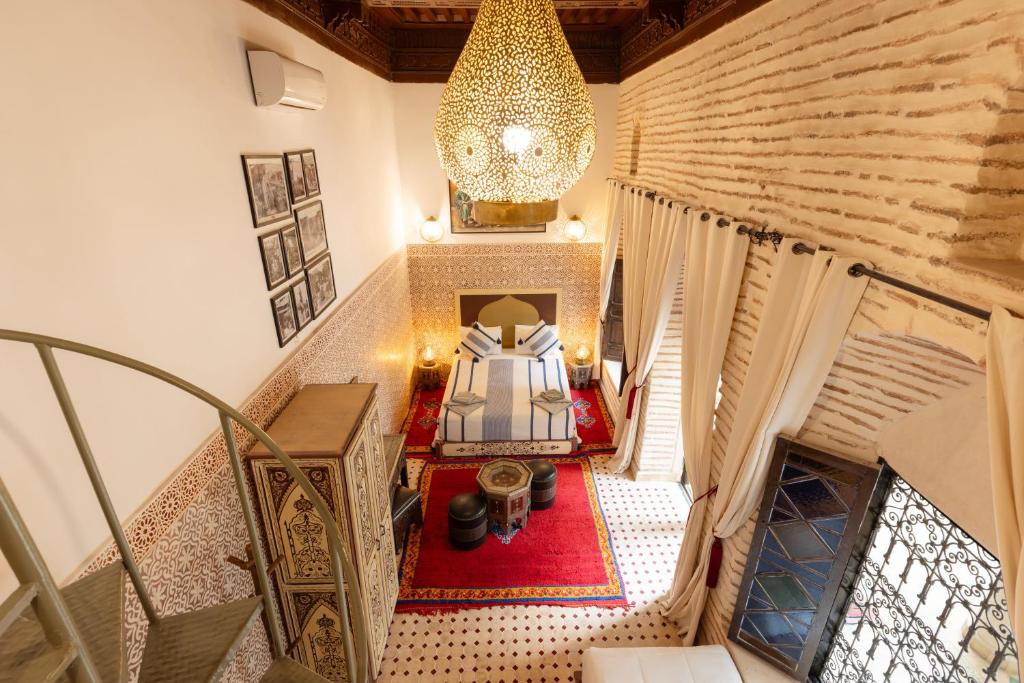
The riad in one definition
A riad is a traditional Moroccan house organized around a central open-air patio. In Marrakech, almost all riads today are restored tourist accommodations.
Seen from the street, it's a blind wall with a door. No windows, no sign, nothing to indicate what's behind. The door opens onto a corridor, the corridor opens onto a patio, and there everything is reversed: air, light, often a fountain, plants, two floors of rooms looking inward. The whole building faces inward. That's almost all you need to know to understand how you sleep there.
Le mot « riad » vient de l’arabe ryad, qui signifie « jardin ». Le terme désignait à l’origine les maisons avec un jardin planté au centre, et il a évolué par usage pour désigner l’ensemble de la maison. Architecturalement, un riad se définit par deux caractéristiques : il est inward-facing (all natural light comes from the patio, never from the street) and vertically organized (2 to 3 floors of rooms around the patio, terrace on the roof).
Une précision utile : en toute rigueur, le « dar » est la maison marocaine traditionnelle dans sa forme générale, et le « riad » est un dar avec un patio central suffisamment grand pour avoir été planté. Tous les riads sont des dars, mais tous les dars ne sont pas des riads. En pratique, l’industrie touristique utilise « riad » pour désigner toute maison de médina restaurée en hébergement, ce qui est commode pour les voyageurs même si ce n’est pas toujours techniquement exact.
The rest of the article is what makes this house particular, how it is lived in, and what you pay to sleep there.
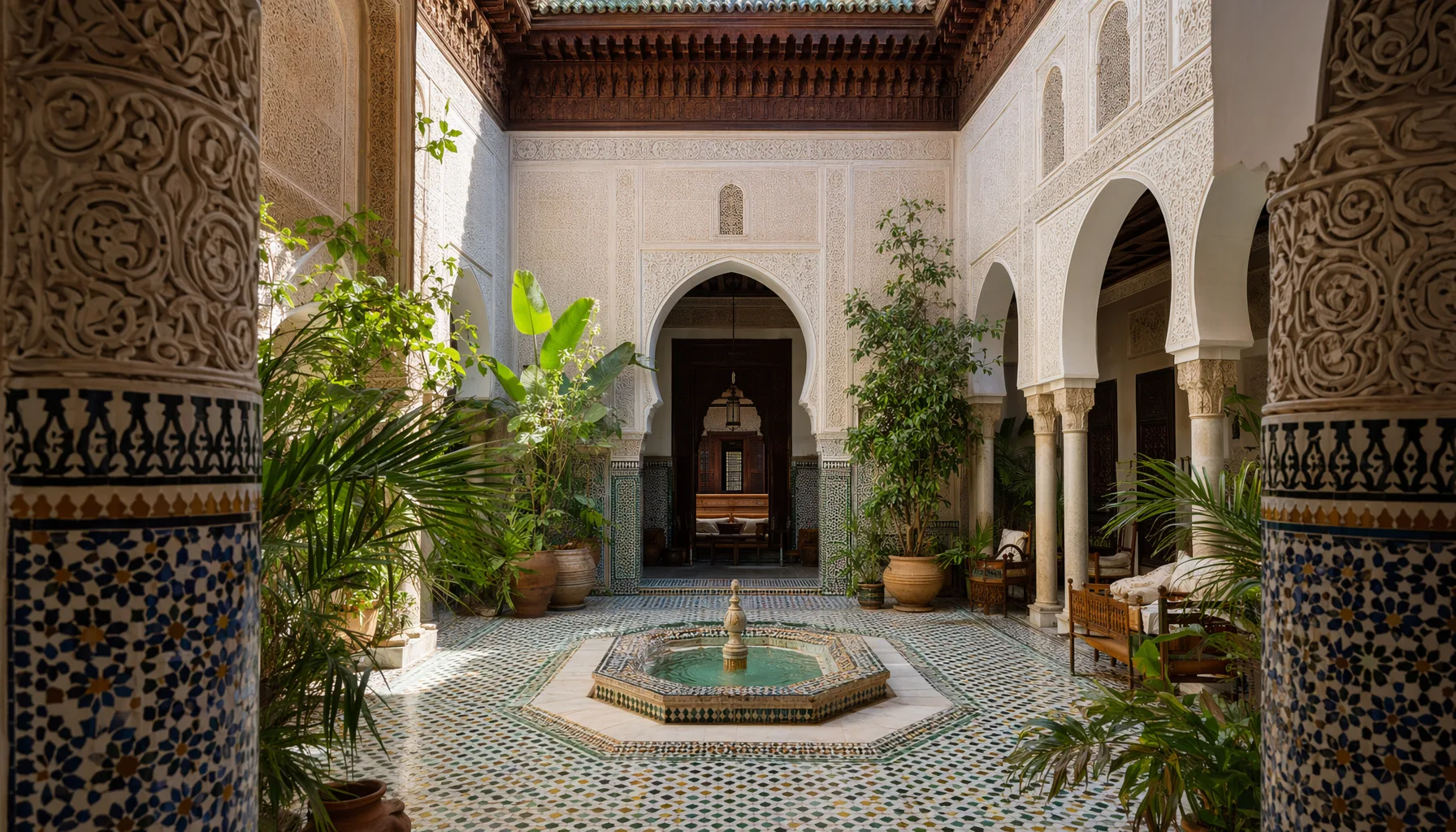
Why this architecture (and why it works)
The riad is not an aesthetic fancy. It is a logical response to a precise climate and a precise culture of intimacy. Houses built this way worked well before air conditioning. Restored riads today still work, with air conditioning on top.
The climate. Marrakech is a dry and hot city, with summers regularly above 40°C and little humidity. Inward-facing architecture is a passive cooling system that predates electricity by a thousand years. The patio works like a thermal chimney: hot air rises and escapes from the top, cool air descends and concentrates at ground level. Thick walls of pisé or brick keep the coolness of the nights. At the peak of summer, the shaded patio is the coolest place in the whole building, and that is where everyone gathers between 2 PM and 4 PM when it is 42°C outside.
Intimacy. Traditional Moroccan culture organizes life around the family and the private circle. The boundary between public and private space is physically marked: no windows on the street, no transition space. You enter, you close the door, you change worlds. The riad has nothing to show to the outside and everything to live inside.
Water. Most riads have a fountain or basin in the patio. Functionally, water cools the air by evaporation. Culturally, the sound of running water in an enclosed space has a meditative quality you don't realize until you have slept there. It is not decorative.
Light. The patio is the only source of natural light. The way that light moves through the space over the hours defines the visual rhythm of the day. In the morning, cool semi-darkness. From 2 PM to 4 PM, the high walls create shadow and the patio is at its most pleasant. Around 6-7 PM, the golden end-of-day light floods the first-floor galleries. Every well-built riad lives by that rhythm.
Recent history. Most current tourist riads are houses bought between the 1990s and 2010 by foreign owners, mostly French and British, who restored them as boutique guesthouses. The best restorations respected the original architecture while adding contemporary comfort. Medina regulations limit building height, which keeps riads at a human scale, generally 5 to 15 rooms.
An example of this architecture in its classic form, with a fountain patio, hammam and inner garden: Riad Dar Hamid Hotel & Spa, rated 9.3/10 across more than 1,100 reviews, Marrakech medina.
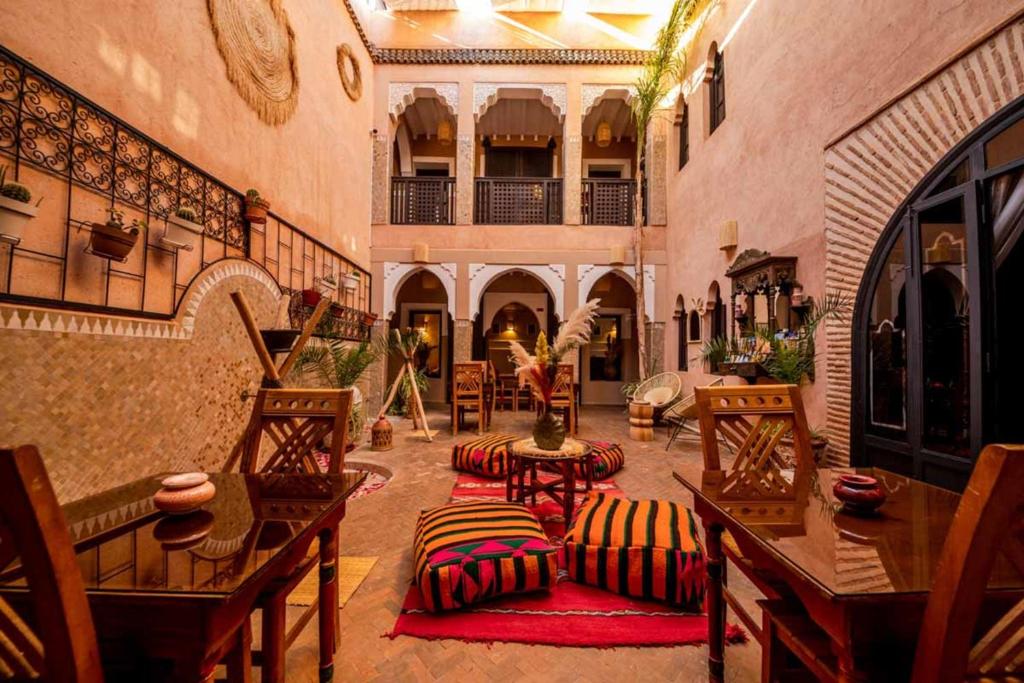
How it's organized: the inner geography of a riad
Understanding a riad's spatial organization helps you read listing photos, choose the right room, and anticipate the experience before arriving.
The ground floor is the heart of the building. The patio occupies the center, often with a fountain or small basin. All around: the living room, the dining room, sometimes a library or lounge corner. The kitchen and service spaces are usually in the back, discreet. If the riad has a formal reception, it is also there. It is the space where everyone gathers for breakfast, afternoon tea, and dinner if the house serves it in the evening.
The first floor is where the rooms are. They open onto a gallery or balcony overlooking the patio. The size can be surprising: 10 to 18 m² is normal in old riads, the rooms being designed for sleeping, not for living in. In well-restored riads, several pieces have often been combined to create suites. In small affordable riads, the original configuration is preserved.
The second floor, when it exists, hosts the best rooms: suites, master rooms, those with access to a private terrace or open balcony. The higher you go, the more light, ceiling height, and often calm you get, because you are further from the patio where the social life happens.
The terrace is the most important space for the tourist experience. It is where you have breakfast on good days, where you gather in the evening with a drink, where you see sunsets over the medina and sometimes the foothills of the Atlas in winter. Terrace quality varies a lot: some overlook other terraces and nothing else, some have a view of the Koutoubia, some are turned into lounges with furniture and plants, others are bare. The terrace is one of the first things to check in the photos.
The hammam, when it exists, is usually in the basement. A small room of 15 to 40 m², often privatizable on reservation. Many small riads don't have one and send their guests to the public hammams of the neighborhood.
A riad that illustrates this spatial play well, with a terrace open onto the medina and rooms with balconies over the patio: Riad 7 Saints, rated 9.3/10 across 850 reviews, Marrakech medina.
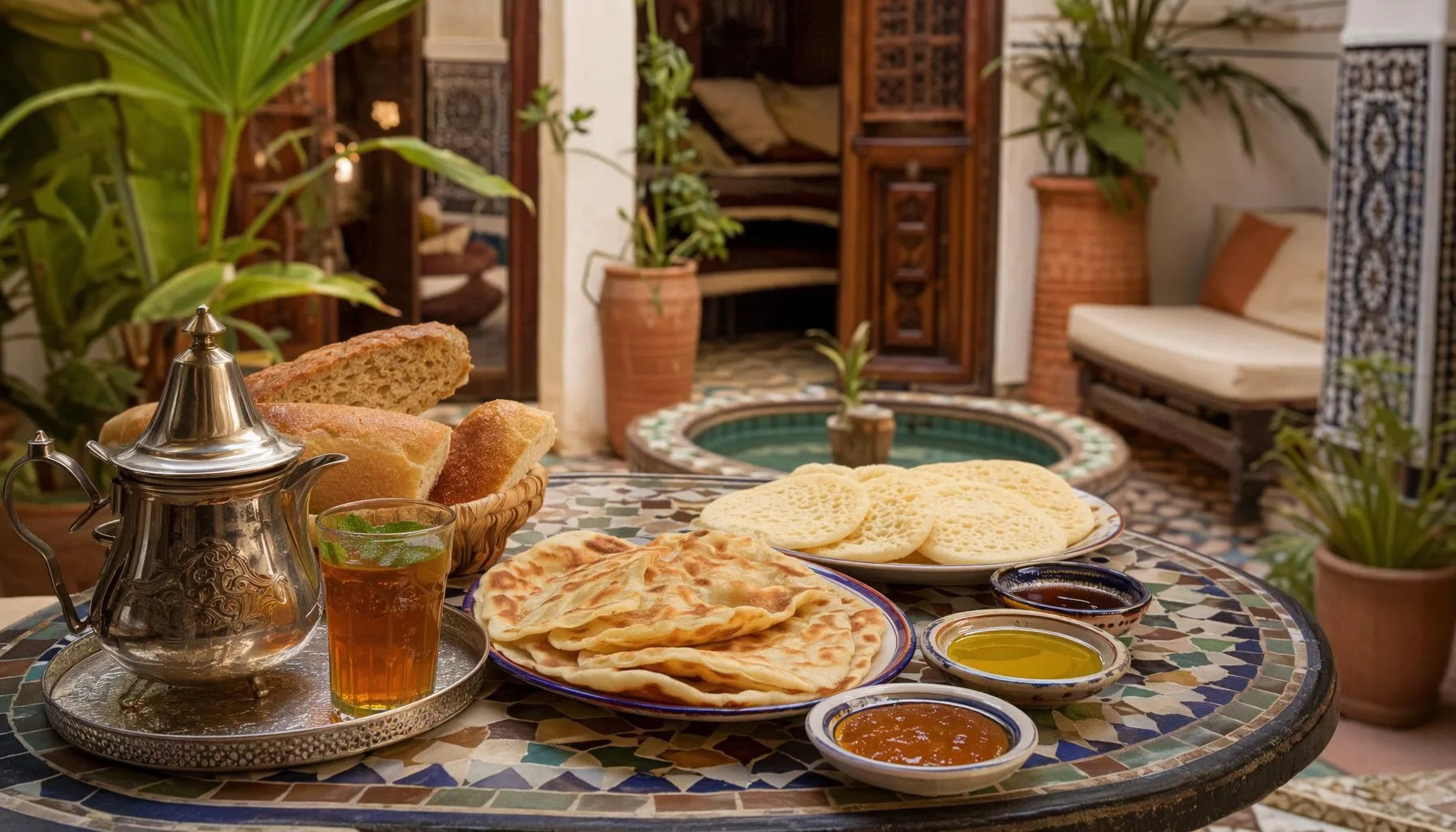
What it is to sleep in a riad: the real experience
In the morning in a riad, breakfast doesn't look like a hotel buffet. It is table service, on the patio or terrace, with fresh bread, olive oil, jam, msmen and beghrir (the Moroccan pancakes), sometimes eggs, mint tea. There are six or eight people in the whole riad, you cross paths. The service window is often 8-10 AM, not 24/7.
During the day, the riad becomes a refuge. You go out in the morning toward the souks, and when the heat rises around 1-2 PM in summer, you come back. The patio at 42°C outside is 28°C in the shade. The place you take refuge in from the city becomes part of the trip. Riads with a pool push the logic even further: the pool in the courtyard is the center of gravity of the afternoon.
In the evening, some riads serve dinner on reservation, often a fixed Moroccan menu on the terrace. Many do not serve dinner and direct their guests to the restaurants of the neighborhood. A good riad team is your informal concierge: they know what is worth it five minutes' walk away, like our recommended addresses in Marrakech.
Service distinguishes the riad from the hotel. A team of 3 to 6 people for the entire house. You see the same face at breakfast, at the door in the evening, when you ask for a taxi. The person bringing the tea is often the one who suggested the restaurant the night before. That scale of relationship doesn't exist in an 80-room hotel. It isn't better or worse, it's structurally something else.
At night, the patio's acoustics deserve mention. The patio amplifies sound between floors: a conversation on the ground floor is audible on the first, an alarm on the second is too in rooms open to the gallery. The fajr call to prayer, around 4:30-5 AM in summer, passes through the walls. It is not a nuisance, it is a reality of the medina that's better to know about beforehand. For this specific topic, our article on the medina at night, what you need to know goes into detail.
The limits are real: fixed-time breakfast, small rooms in old riads, sometimes insufficient air conditioning in lightly renovated houses, English not always strong in small family-run structures (French is much more common). And on the first evening, finding your riad in the derbs can be disorienting. Most riads send someone to pick up arrivals at the nearest landmark.
A riad that illustrates this scale of intimate service well, with a particularly strong staff-guest relationship: Riad Mylaya, rated 9.7/10 across 396 reviews, Marrakech medina.
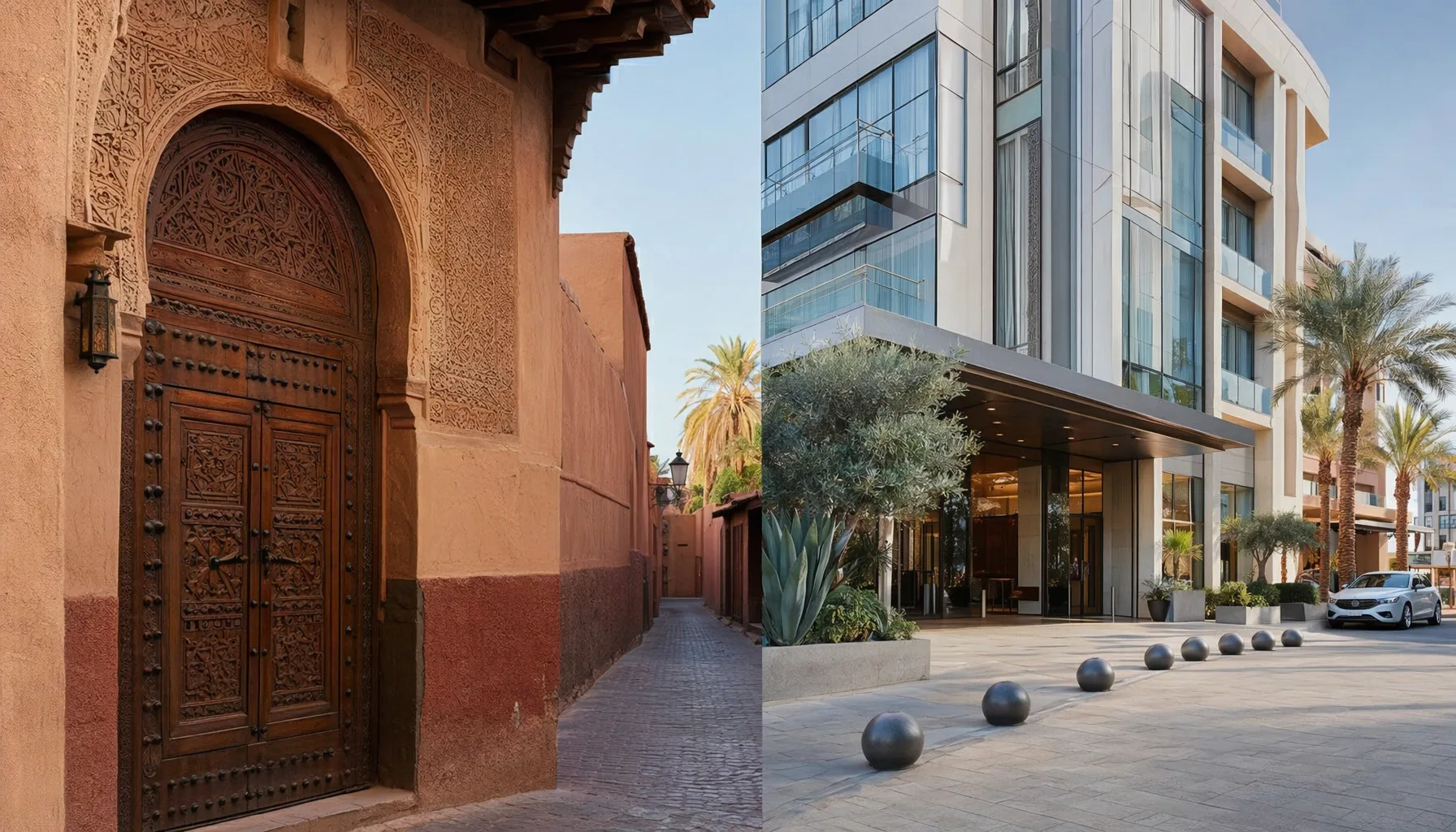
The riad vs other formats: the quick take
This section is deliberately short. The full topic, with all the decision criteria, is the subject of a separate article. The idea here is just to set the frame.
The riad makes sense when you came for the Marrakech experience and not just for a transit city. When traveling with 1 or 2 people, sometimes 3 or 4 in a whole house on a private buyout. When you appreciate that the accommodation itself is part of the trip rather than a bed between two outings. When you don't have specific amenity requirements: you aren't looking for a gym, a 24-hour gourmet restaurant, or an Olympic pool.
The hotel makes sense when you have needs that riads don't cover well: certified air conditioning in extreme summer, night service, multiple restaurants, gym, easy car access. For large families with young children, the hotel often has better-adapted infrastructure. For short business trips that require precise logistics. For someone who has already done the riad and is looking for something different on this stay.
The apartment or villa works for long stays of 10 nights or more, for large groups of friends, for profiles wanting full autonomy and a kitchen on site.
To go further on the riad-versus-hotel choice specifically, we have a whole article on it, coming soon.
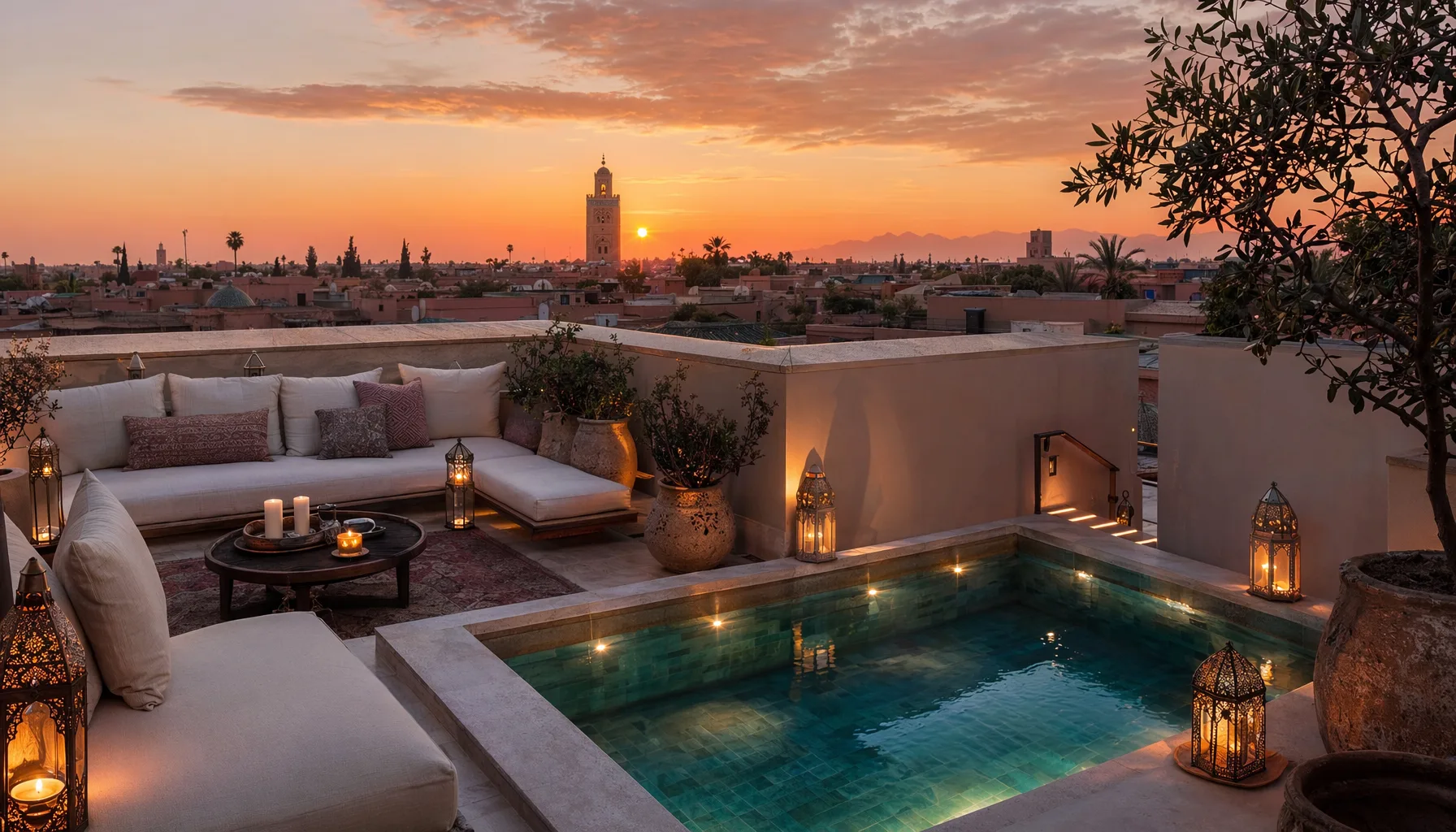
How much does a riad in Marrakech cost?
C’est la question qu’on nous pose toujours. Les prix varient selon la saison, la qualité de la maison, l’emplacement et la taille de la chambre. On passe par des paliers qualitatifs : à chaque palier correspond une expérience différente, pas juste un prix différent.
Affordable riads
Small family-run structures, often 4 to 8 rooms, in residential derbs a bit removed from the tourist core. Rooms are small, bathrooms modest. No pool generally, no in-house hammam. What compensates: the welcome is often very personal, breakfast prepared in-house, real value for money. Reviews of this segment almost always praise the warmth of the welcome and the quality of breakfast, rarely the amenities.
Mid-range riads
Le segment le plus dense de l’offre marrakchie. Maisons bien restaurées, chambres confortables, souvent un petit bassin ou une piscine de patio, parfois un hammam. Service professionnel sans être impersonnel. La grande majorité des riads bien notés sur les plateformes de réservation appartient à cette catégorie. C’est généralement là que se situent les « bonnes trouvailles » dont parlent les voyageurs à leur retour.
High-end riads
Careful restoration, large rooms or suites, in-house hammam with practitioners, often an in-house restaurant or terrace dinner service, dedicated team. The architect or designer is sometimes known. The house has a strong identity. You come as much for the place as for Marrakech.
Ultra-luxury (signature) riads
Very few, 10 to 15 in Marrakech. These houses have their own reputation, sometimes a presence in architecture press or design guides. The restoration mobilized specialized craftsmen (zellige maalems, plaster sculptors, cedar-wood carpenters), the rooms are spacious, the service is close to a palace but at the scale of a house. The visit is an end in itself. An example of this register, with a central fountain patio, hammam and terrace view of the medina: Riad Dar des Arts, rated 9.6/10 across 222 reviews.
Ce qui fait varier le prix : la saison (haute saison mars-mai et octobre-novembre coûte typiquement 30 à 50% de plus), l’emplacement (médina centrale vs derb résidentiel), la taille de la chambre (suite vs standard, facteur 2 à 3 dans le même riad), et ce qui est inclus (le breakfast presque toujours, le reste variable).
Un piège courant : un riad qui affiche des aménités de luxe à un tarif inférieur au milieu de gamme est presque toujours une mauvaise surprise. Photos anciennes, maintenance négligée, ou « aménités » facturées en extra. Calibrer ses attentes sur le tarif réel, pas sur la liste des promesses.
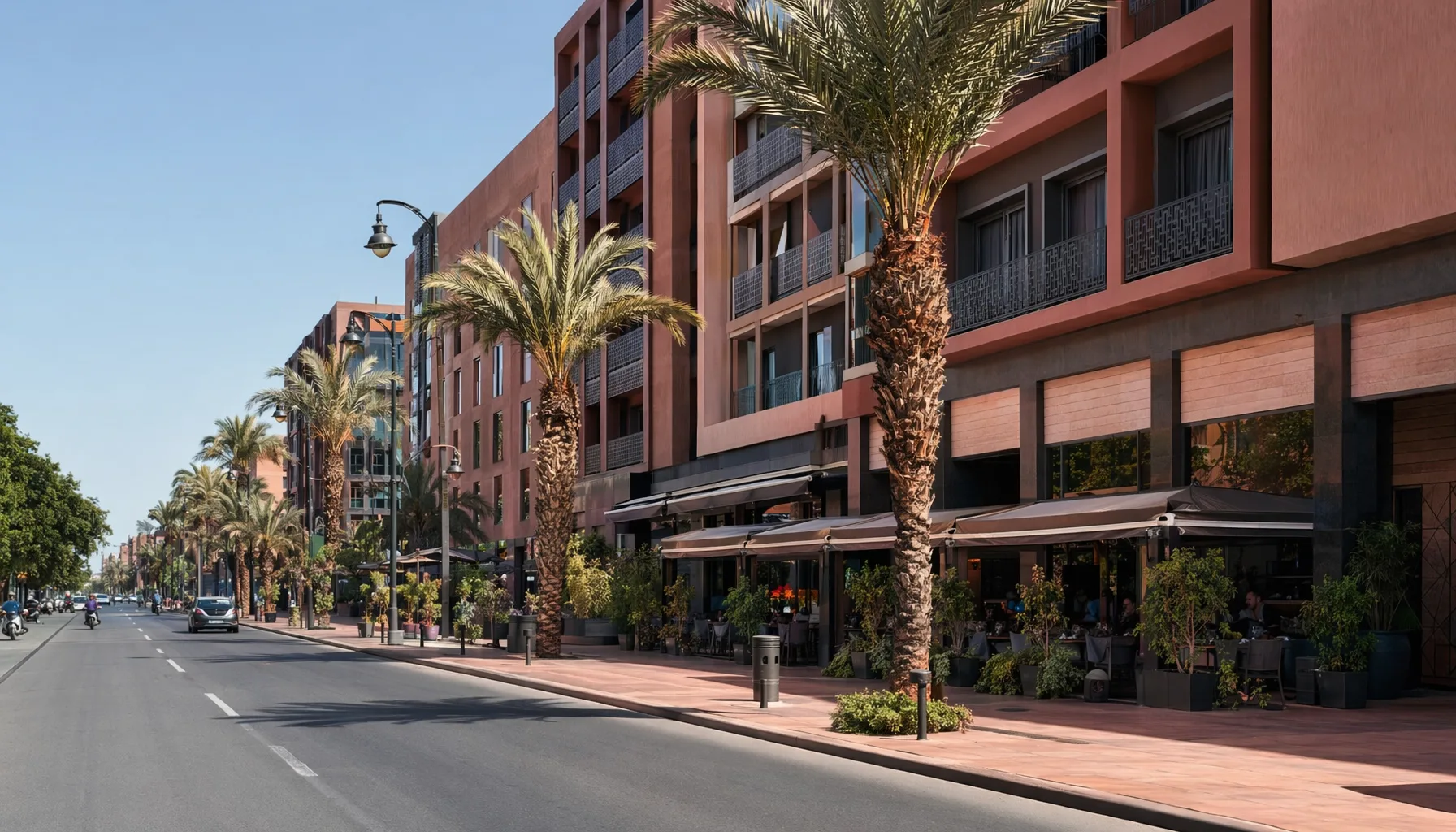
When a riad isn't the right answer
If you need absolute predictability, old riads have heterogeneous air conditioning. In lightly renovated houses, the AC can be insufficient in summer and heating problematic in winter. A recently built hotel is more reliable.
Si vous voyagez avec un nourrisson, l’acoustique du patio mérite attention. Un enfant qui pleure la nuit est entendu par tous. Plusieurs petits riads sont explicitement « adultes seulement » pour cette raison. Pour les familles avec jeunes enfants, notre guide the best addresses for a family stay in Marrakech is a better starting point.
If you have accessibility needs: several floors without an elevator, often steep stairs. Riads are generally not adapted to reduced mobility. Modern hotels are more accessible by default.
If you stay ten nights or more, the intimacy of the riad can become a constraint. An apartment or a privatized villa fits long stays better.
If you expect the service of a large international hotel, the riad format is not it. At night, many riads have no physical staff on site after 11 PM. You get in by WhatsApp or by ringing the door.
None of these profiles is wrong. The riad is a specific form with its strengths and limits. Choosing well means knowing which apply to you.
Frequently asked questions about riads in Marrakech
What is a riad in Marrakech?
Un riad est une maison traditionnelle marocaine organisée autour d’un patio central à ciel ouvert. Le mot vient de l’arabe et signifie « jardin ». Le bâtiment est tourné vers l’intérieur : pas de fenêtres sur la rue, toute la lumière et la vie sociale viennent du patio. À Marrakech, la quasi-totalité des riads sont aujourd’hui des hébergements touristiques restaurés, de 4 à 20 chambres. On y dort comme chez quelqu’un, pas comme dans un hôtel.
What is the difference between a riad and a hotel?
Architecture first: the riad is a medina house with a central patio, rooms around a courtyard, terrace on the roof. The hotel is designed for mass accommodation, with corridors and permanent reception. Scale next: riads have 4 to 20 rooms. Service last: a small team you see throughout the day. Our riad or hotel guide details the choice criteria.
What is the difference between a riad and a dar?
Le dar est la maison marocaine traditionnelle dans sa forme générale. Le riad est un dar avec un patio central suffisamment grand pour avoir été planté. Les deux sont inward-facing, sans fenêtres sur la rue. Dans le tourisme marrakchi, « riad » désigne toute maison de médina restaurée en hébergement, même celles qui seraient techniquement des dars.
How much does a night in a riad in Marrakech cost?
Les prix varient selon la saison, la qualité de la maison, l’emplacement et la taille de la chambre. On distingue quatre paliers : riads abordables (petites structures familiales, confort simple, accueil chaleureux), milieu de gamme (le gros de l’offre, bien restauré, souvent avec piscine), haut de gamme (boutique-luxe, design affirmé), et riads signature (une quinzaine à Marrakech, maisons qui ont leur propre réputation). La haute saison, mars-mai et octobre-novembre, coûte typiquement 30 à 50% de plus que la basse saison.
Should you choose a riad for your first stay in Marrakech?
For the vast majority of first-time travelers, yes. A riad in the medina places you directly in the city's context, within walking distance of the souks and Jemaa el-Fna, with a lodging experience that is part of the trip. There are exceptions: traveling with young children, accessibility needs, expecting large-hotel amenities. For other profiles, it is often the choice travelers remember best.
Are riads all-inclusive?
Breakfast is almost always included: table service on the patio or terrace, with a traditional Moroccan platter (msmen, beghrir, fresh bread, jam, olive oil, mint tea or coffee). Dinner is sometimes offered on reservation, often on a fixed Moroccan menu. Hammam, treatments, airport transfers and drinks are variable by establishment. Checking what is included before booking avoids surprises.
Is there air conditioning in riads?
Most riads have air conditioning, added afterwards to buildings not designed for it. In well-restored riads, summer cooling works well. In small old riads, the AC can be insufficient above 40°C. In winter, heating is more problematic: nights in December-January drop to 5-7°C.
Do riads accept children?
La plupart acceptent les enfants, mais pas tous. Certains sont explicitement « adultes seulement » pour préserver le calme du patio. Il n’y a pas d’ascenseur, les escaliers sont souvent raides, les toits-terrasses pas toujours sécurisés. Pour les familles avec jeunes enfants, notre guide where to stay with family in Marrakech is a better starting point.
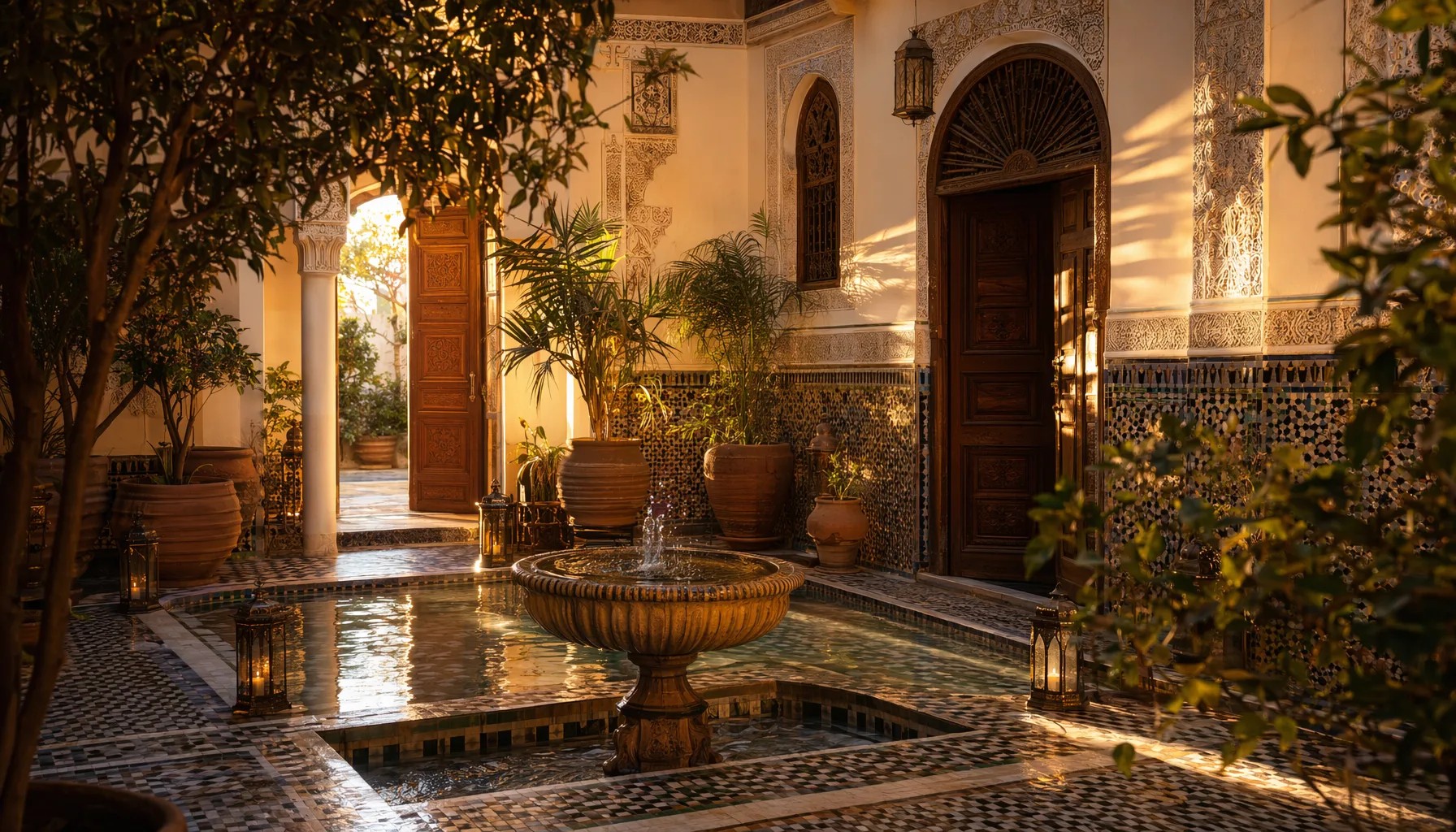
To finish
A riad is a house, not a hotel. That is what makes it interesting, and that is also what means knowing when it works for you and when it does not. The article has laid the groundwork.
Going further: if the question is choosing the right neighborhood, our complete overview of accommodations in Marrakech covers all neighborhoods and types of lodging. To compare the medina to Guéliz specifically, our medina or Guéliz comparison settles it case by case. And for fans of spa and hammam in a riad, our selection of riads with spa and hammam is over there.