




Riad or Hotel in Marrakech — Which One to Pick for Your Trip, Honestly
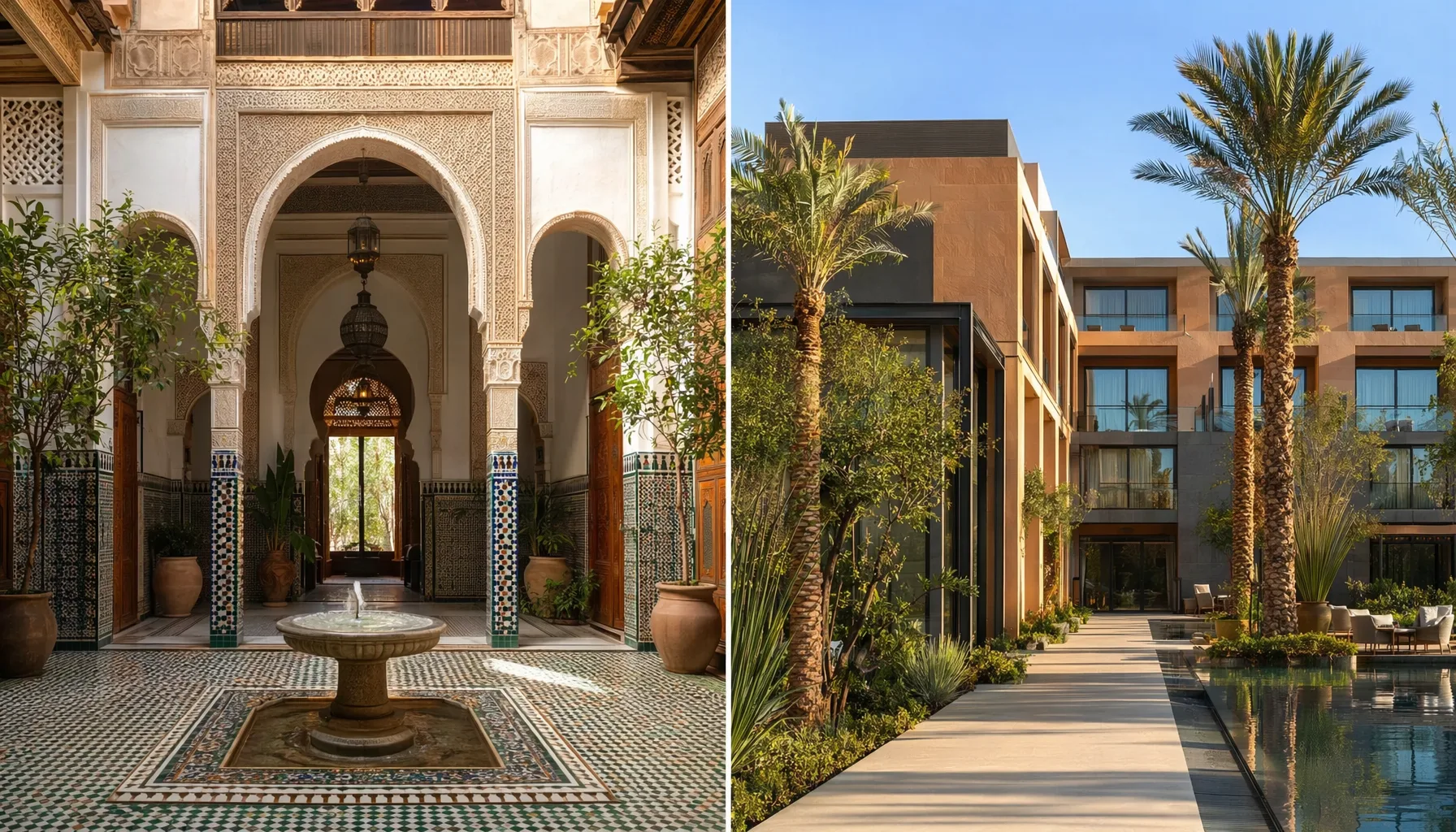
Riad or hotel in Marrakech: the real question to ask
Riad ou hôtel à Marrakech, c’est une vraie question, pas un faux dilemme. Les deux sont de bonnes options pour des voyageurs différents, et la réponse honnête dépend moins de votre « style de voyage » que de questions concrètes : voyagez-vous avec un nourrisson ? Restez-vous 3 nuits ou 10 ? Avez-vous des besoins d’accessibilité ? On va passer en revue les deux formats, puis donner notre avis franc.
The riad-hotel question actually comes downstream of two earlier decisions. The first: which neighborhood? If you have already settled on the medina, you are mechanically in riad territory: 90% of them are concentrated there. If you want Hivernage or the Palmeraie, it is the hotel by default. For that neighborhood decision, we have a dedicated article on How to choose between the Medina and Gueliz. The second: what kind of stay? That is where the riad-hotel choice takes on its full importance, and that is what this article deals with.
Our take, after hundreds of conversations with travelers: the riad wins 70% of the time for a first stay. The remaining 30% are not mistakes, they are specific profiles where the hotel is the right answer, not a compromise. If the notion of riad is not yet clear to you, what is a riad, exactly, we have a full article on the subject. The rest of this article compares the two formats and gives the decision framework.
The riad: what it is, what you do with it
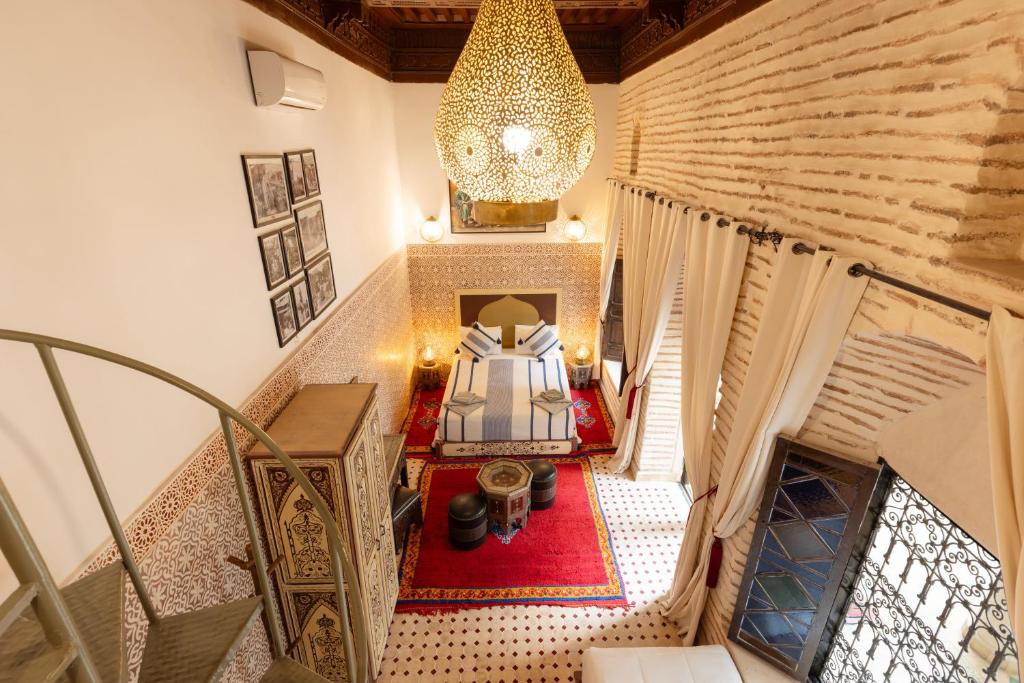
In a riad, you live in the house. In the morning, you have breakfast in the patio with two or three other travelers you will also cross paths with at the apéritif. The staff recognizes you by the second day. The building is sometimes 80 years old and makes you feel it: the light dropping vertically onto the zellige at midday, the smell of painted wood in the stairs, the coolness of the courtyard at 3 PM when it is 38°C outside. It is very specific.
The atmosphere of a riad is immersive and architectural. The inner courtyard structures the rhythm of the day: that is where you gather in the morning, where you set down your afternoon coffee in the shade. You feel inside the city rather than perched above it.
The scale is small, typically 5 to 15 rooms. You will never be anonymous. It is a quality or a drawback depending on your temperament. The service is at that scale: a small team, often partly family-run, less formal than a hotel and often more attentive. Breakfast served in the patio, dinner sometimes offered on the rooftop terrace, neighborhood advice given without a commercial agenda.
Riad locations are 90% medina. A few exist in Guéliz, modern restorations in old houses, but it is rare. Outside of those two zones, the format does not exist. Which means choosing a riad almost always means choosing the medina.
The format's limits are real. Rooms are often small. The elevator is the exception, not the rule. Air conditioning can be uneven in old buildings, hot water sometimes erratic in winter. Reception is not 24/7 in many cases: you ring, you WhatsApp. For travelers who need absolute predictability on those points, it is a risk to weigh. For others, the best riads are flawless on all those aspects.
To go further on the format, its variants, its prices, and its history, the riad explained and its price is the reference article. What follows is the comparison with the hotel.
Riad Dar Hamid Hotel & Spa, in the medina with a rooftop, an in-house hammam and an integrated spa, rated 9.3/10 across more than 1,100 verified reviews, illustrates what the format delivers at its best: pool in the inner courtyard, terraces on several levels, the whole house wrapping around you from the entrance.
The hotel: what it is, what you do with it
In a hotel, you have a lobby, an efficient check-in, a key card, a room service reachable at 11 PM. The pool is 25 meters long and usable in November because it is heated. The breakfast buffet has fifteen options. You can disappear for three days without any staff member knowing what you spent your days on. It is also very specific.
The hotel in Marrakech is the predictable format in the good sense of the word. International standards, recent equipment, constant maintenance. The lobby greets you with the codes you recognize from other trips. Comfortable in a reassuring way, no surprises.
The scale is different: 50 to 300 rooms depending on the establishment. You will not see the same staff faces twice. Anonymous in the good sense: no one imposes sociability on you, no one expects you to recount your day. For certain travelers (the shy, the exhausted, couples who just want to be alone together), it is exactly the right mode.
The service is structured. 24/7 reception, room service until late, several restaurants on site, dedicated concierge with calibrated answers. It is not personal, but it is reliable. When you need something at 2 AM with a sick child, that reliability is worth a lot.
Hotel locations cover the entire territory of the city. Guéliz for the modern and central, Hivernage for quiet luxury two steps from the medina, Palmeraie for resorts with large grounds and outsize pools, medina-adjacent for a few addresses near the gates. If you want Hivernage or the Palmeraie, the choice is mechanically the hotel.
The real strengths of the hotel in Marrakech: a pool often heated and usable in all seasons, recent and efficient air conditioning, an elevator going to every floor, available family rooms, a multilingual staff that avoids misunderstandings. For long stays or varied needs, the hotel lets you have everything on site without going out for each daily errand.
The international hotel in Marrakech is not a less authentic trip. It is just a different trip.
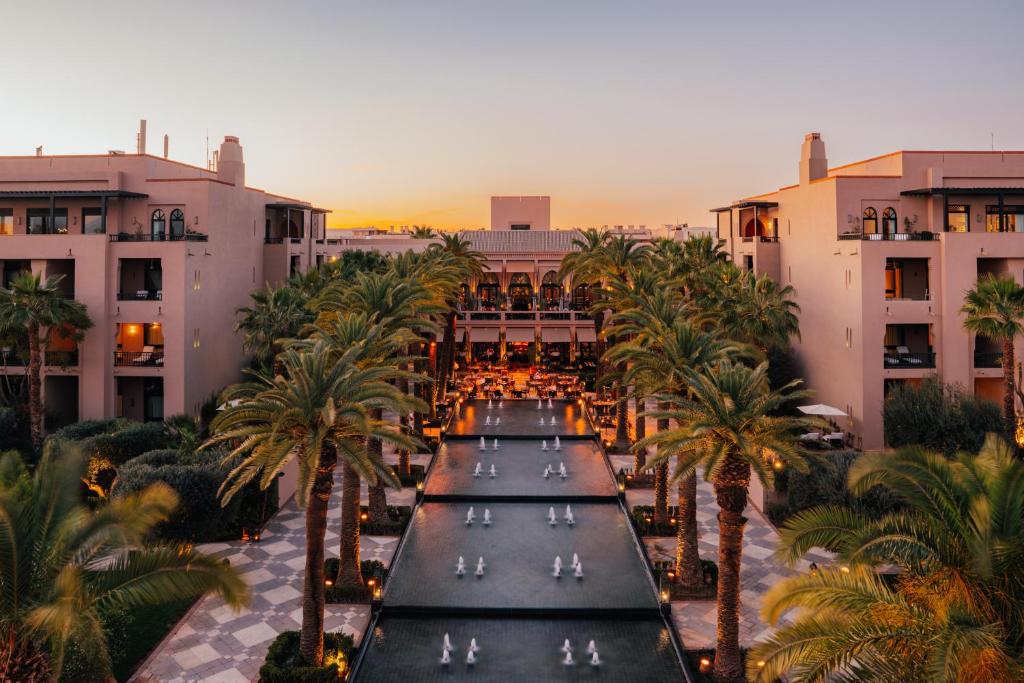
Four Seasons Resort Marrakech, in Hivernage with two pools, five restaurants and a standalone spa, rated 9.2/10, illustrates what the international hotel segment offers at its best in Marrakech: the medina ten minutes by taxi, the Majorelle Garden on foot, and everything you can expect from a world-class palace once back.
The real differences, criterion by criterion
Atmosphere and sensory experience
The riad is architectural immersion. You sleep in a real Moroccan house. The inner courtyard, the fountain, the zellige. Morning on the terrace with coffee, the silence of the afternoon in the shaded patio. The experience is spatial and tactile from the first evening. If it is the Marrakech-experience you came for in an architectural sense, the riad wins on this point without discussion.
The hotel is predictable comfort. A lobby, a buffet, a pool. Very well done in the good addresses, but it will not give you the texture of the Moroccan house. For travelers who came not for the architecture but for the gastronomy, the excursions or pure rest, it is no loss.
Predictability (sleep, A/C, hot water, light)
Riads vary by house. The best are flawless: silent air conditioning, constant hot water, well-insulated windows. Average riads have inconsistencies that surface on the second evening: the A/C that only half-cools, hot water that takes five minutes to arrive, room heating insufficient in January. The building's age plays a role, and it is not always visible in the photos.
The hotel is highly predictable. International standards, recent equipment, constant maintenance. If predictability matters to you in a non-negotiable way (medical constraint, fragile sleep, business trip), the hotel reassures where the riad can disappoint.
Service and human relationship
In a riad, you will see the same person several times. The relationship can become almost friendly over a 4 to 5 night stay. If you enjoy that, it is precious. If you prefer anonymity or if obligatory small-scale sociability weighs on you, it is too much. Some travelers find the riad's scale claustrophobic by the third day.
In a hotel, the service is structured and impersonal in the good sense: you ask reception for something, you get it. No need to recount your day to anyone. For romantic couples who want to stay in their bubble, or for those who need a stay without social load, it is the right mode.
Amenities (pool, restaurants, gym, business)
Riads have limited amenities. A small plunge pool on the terrace or in the courtyard, sometimes an in-house hammam, rarely a gym. The riad pool is rarely heated and rarely usable between October and April. A single in-house restaurant in the best cases, often only breakfast. For everything else, you go out.
Hotels are complete. Real-size pool (often heated), two to three on-site restaurants, gym, business center, sometimes a standalone spa. For long stays or for travelers who want everything on site, the hotel avoids going out for each errand. It is a concrete advantage over seven nights.
Family and accessibility
The riad is difficult for families with young children. No elevator in the majority of cases, small rooms, noise spreading through the open courtyard, little baby equipment, no overnight room service. Many riads apply a minimum-age policy, often 12, sometimes 16. It is not arbitrary discrimination: the architecture does not lend itself to it.
With a 6-month-old, the medina-riad becomes a constant logistical calculation. No stroller in the derbs, no elevator in the riad, the patio noise crossing the courtyard, no overnight service. The hotel in Guéliz is not a retreat in that case, it is just the correct answer to a calculation. A good night for the parents is worth far more than the authenticity of a patio.
For accessibility and reduced-mobility needs, same conclusion: the hotel is suited, the riad generally is not.
Location
The riad is the medina at 90%, Guéliz at 10% (rare riads, often modern). No other neighborhoods. If your neighborhood choice takes you to Hivernage, Palmeraie or Agdal, this format is not available. For neighborhood-choice questions, our article on medina or Guéliz: we settle it is the logical complement.
The hotel covers everything: Guéliz (45%), Hivernage (25%), Palmeraie (15%), medina-adjacent (10%), other zones (5%). More geographic choice. If you want Hivernage or the Palmeraie, it is mechanically the hotel, and that is not a compromise on access to the city.
Price and value for money
The riad has a wide spectrum. Small charming riads at 60-100€ per night with excellent value for money; high end at 200-500€ and beyond. The sweet spot is often in the 120-180€ range: well-kept houses, personalized service, a setting that justifies the price. The finds exist at this level.
The hotel has a more compressed mid-range. International 4-star chain hotels run between 100 and 180€, 5-stars between 250 and 500€. There are fewer pleasant surprises on value for money because international chains position themselves with thin margins. A well-chosen 130€ riad often beats a 160€ chain hotel on raw experience.
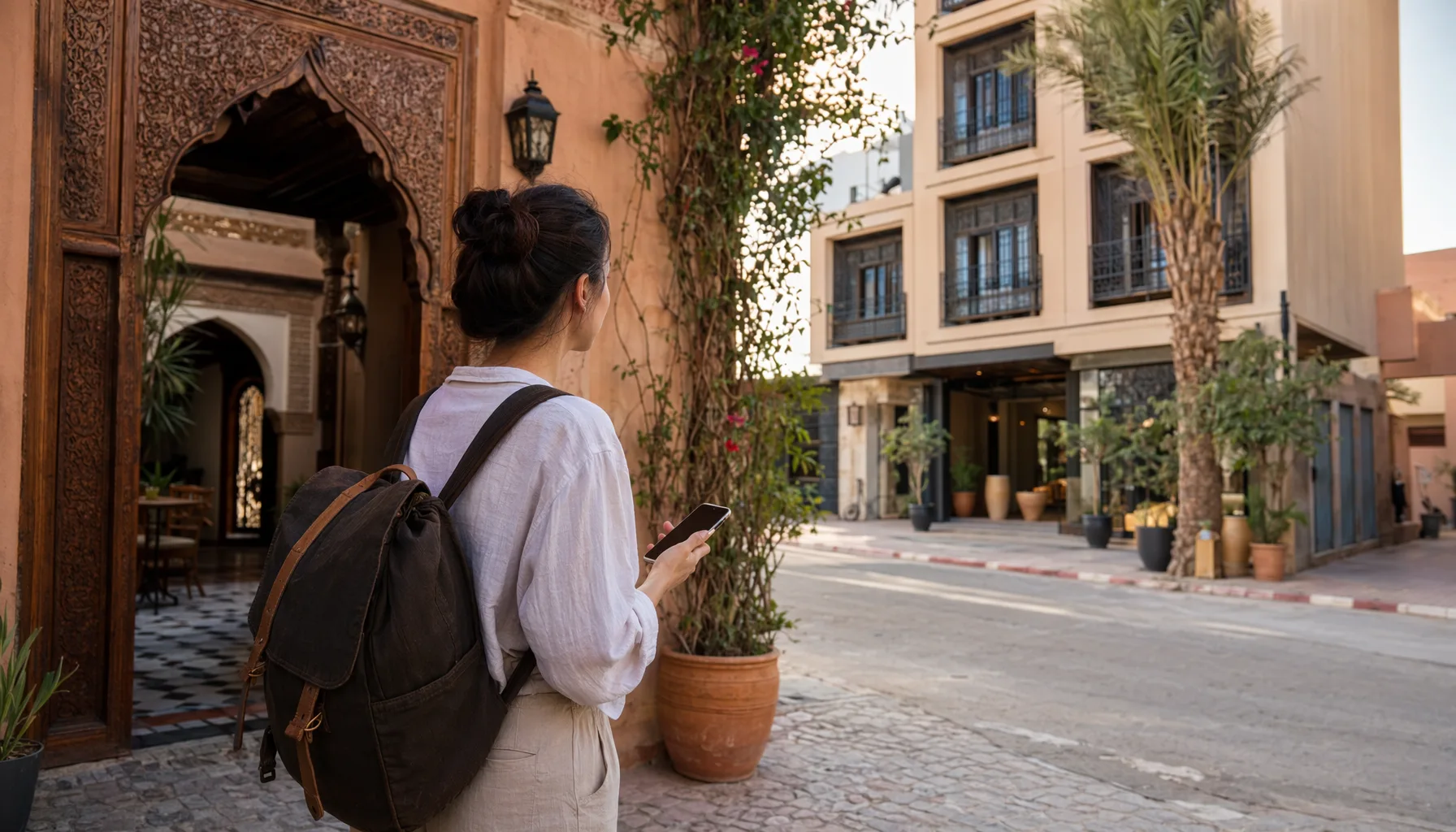
Who each format is the right answer for
Sleeping in a riad is the right answer if:
- it is your first stay in Marrakech (the format is part of the experience)
- you want the Moroccan architecture and atmosphere, not just a base in the city
- Are you traveling as a couple or as adults?
- you are staying 2 to 5 nights (the ideal length for this format)
- you do not need absolute predictability on amenities
- you enjoy the small scale and the personal relationship with the staff
For a first couples trip, Riad Esmeralda, in the medina with a pool and a rooftop terrace, rated 9.6/10, illustrates what the format delivers in its couples version: a private inner courtyard, a pool usable in season, and the architecture of the Moroccan house at its best.
Sleeping in a hotel is the right answer if:
- you are traveling with an infant or young children
- you have accessibility or reduced-mobility needs
- you are staying 7 nights or more and need a stable daily routine
- you want Hivernage or the Palmeraie as a neighborhood
- you are traveling for business with business needs (professional Wi-Fi, meeting rooms)
- you are very sensitive to inconsistencies (sleep, A/C, hot water)
- you want a purely restful stay with a pool usable in any season
- it is your second or third stay in Marrakech and you have already done the riad
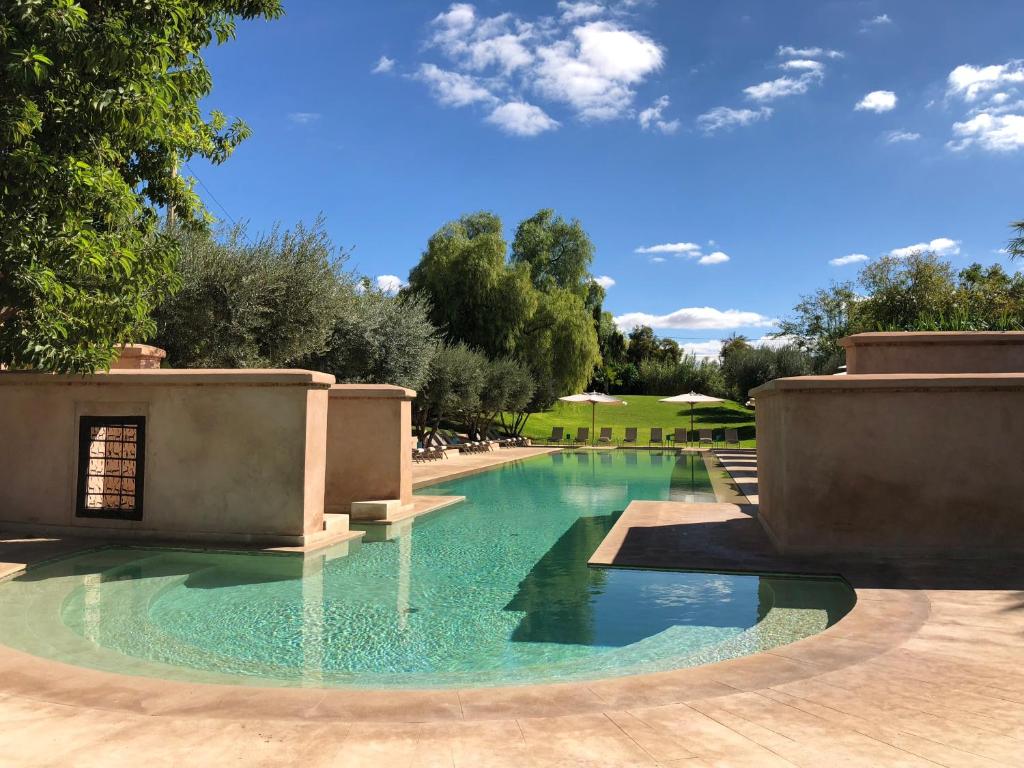
For families with children or stays of ten days or more in the Palmeraie, The Two Towers, a charming resort in the Palmeraie with pools set in a 1.5-hectare park and rated 9.3/10, is the address that reconciles hotel comfort with an authentic Moroccan setting: lush gardens, signature architecture, human scale despite the amenities.
What we say to a friend who asks: first trip, riad in the medina, 4 nights. Second trip: hotel in Guéliz if you want to switch register, or riad elsewhere if you want to dig deeper. With a baby: hotel, no hesitation. For a wedding anniversary, it is Riad Dar Beldia and Spa, medina, pool, 9.6/10 architecture, period. For ten days of remote work: hotel in Guéliz, the riad doesn't hold up over that length.
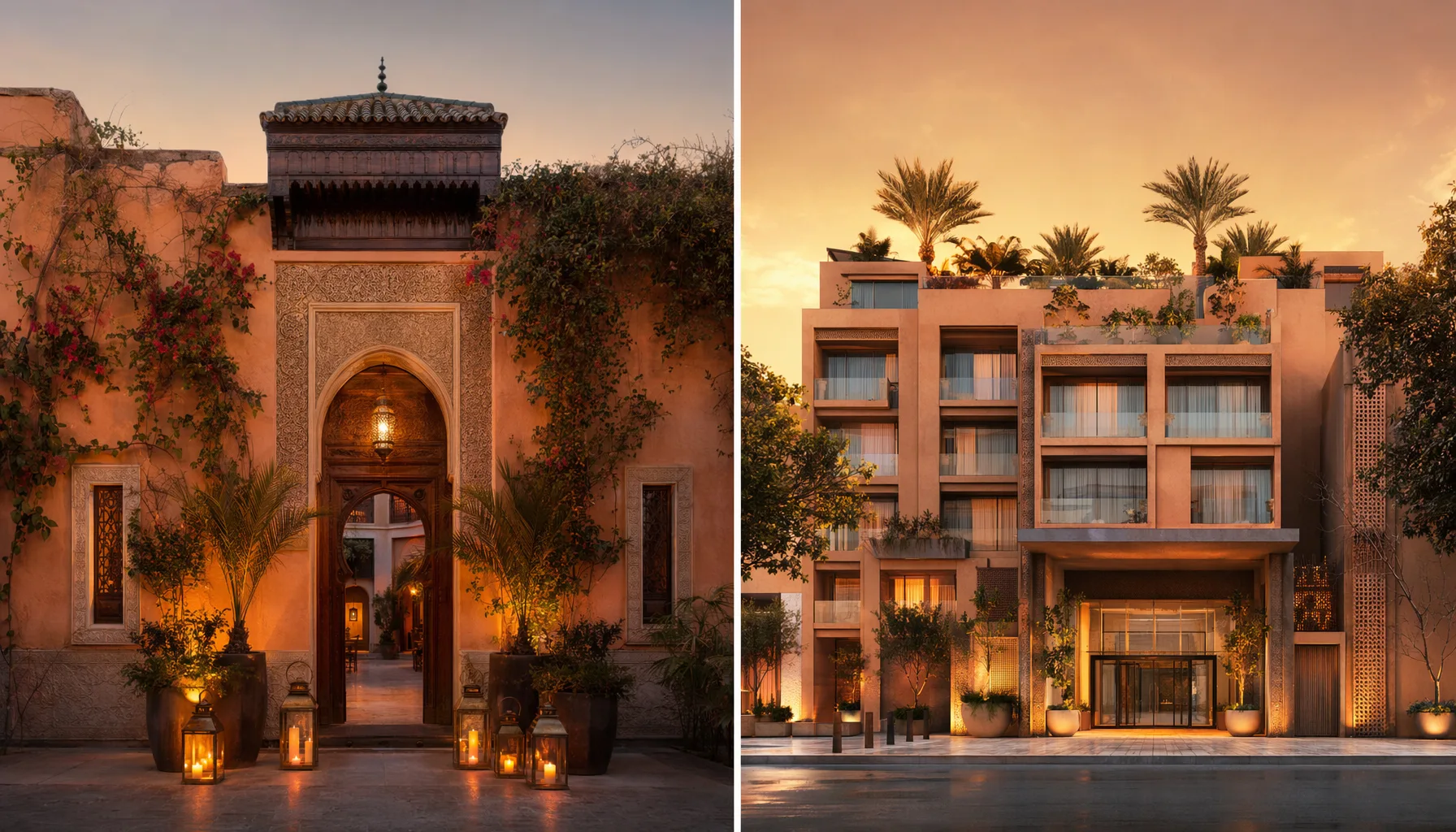
The summary table
A summary of the differences that really matter. For travel profiles and detailed recommendations, the previous section is more useful than this table.
| Criterion | Riad | Hotel |
|---|---|---|
| Vibe | Immersive and architectural | Predictable comfort |
| Predictability (A/C, water, sleep) | Variable by house | High |
| Service | Personal, small scale | Structured, anonymous |
| Pool usable in any season | Rarely | Yes (often heated) |
| Family with young children | Difficult | Suited |
| Accessibility (elevator, mobility) | Limited | Standard |
| Neighborhoods available | Medina, little Guéliz | All (Guéliz, Hivernage, Palmeraie, medina) |
| Ideal length of stay | 2-5 nights | 5 nights and more |
| Average value for money | Wide spectrum, mid-range sweet spot | Compressed mid-range |
| Ideal for | First stay, couples, architectural experience | Families, long stays, return visits, business |
Frequently asked questions about riad or hotel in Marrakech
Is it better to sleep in a riad or a hotel in Marrakech?
For a first stay, the riad is the right answer about 70% of the time. It's the format that best fits discovering Marrakech: the architecture, the atmosphere, the human scale, the medina location. The remaining 30% are specific profiles where the hotel is the real answer: families with young children, accessibility needs, stays of 7 nights or more, business travelers, return visits to Marrakech. Neither is a compromise for the right profile.
What is the difference between a riad and a hotel?
A riad is a traditional Moroccan house with an inner courtyard, converted into accommodation. Small scale (typically 5 to 15 rooms), zellige and stucco architecture, small staff, almost exclusive medina location. A hotel is a standardized establishment: lobby, 24/7 reception, pool, restaurant, numbered rooms. For the full definition of the riad, its history and how it works, riads: definition, how they work, prices is the reference article.
Is a riad more expensive than a hotel in Marrakech?
No, on average. The riad spectrum is wide: 60-100€ for small charming riads, 120-180€ for the price-quality sweet spot, 200-500€ for the high end. International 4-star hotels start at 100-180€ and offer fewer good-value finds in the mid range. A well-chosen riad at 130€ often beats a chain hotel at 160€ on experience quality.
Are there riads suited to families with children?
Yes, but it's a minority. Most riads apply a minimum-age policy (often 12) or are simply poorly equipped: steep stairs, open courtyards, no family rooms, no overnight service. If you're traveling with young children, systematically check the age policy, the existence of connecting rooms, and the accessibility of common spaces before booking. Our Marrakech family accommodation guide lists the most suitable options.
Should you prefer a hotel when traveling to Marrakech in winter?
Not necessarily, but the hotel has concrete advantages in winter. Hotel pools are often heated, rooms are better insulated, and heating systems are more recent. In a riad, the pool is rarely usable between October and April and the heating can be uneven depending on the building's age. For the cold-sensitive or for January-February stays, the hotel offers more guaranteed thermal comfort. For others, a good riad with verified heating remains perfectly viable in winter.
Are hotels in Marrakech just as authentic as riads?
That's a badly framed question. Architecturally, no: an international hotel doesn't give you the experience of a Moroccan house. But in the sense of a real Marrakech experience, the answer is more nuanced. A traveler who spends their days in the souks, eats in local restaurants, and explores the city from a hotel in Guéliz lives Marrakech fully. The authenticity of a trip isn't measured by the architecture of the building you sleep in.
Which format should you choose for a romantic trip to Marrakech?
The high-end riad, almost without exception. The inner courtyard, the personalized service, breakfast on the patio, the private terrace in the evening: the luxury riad in the medina is the format best suited to a stay for two in the city. For the addresses that really work for special occasions, the most romantic riads in Marrakech is our dedicated selection.
Can you combine a riad and a hotel on the same trip?
Yes, and it's even a good strategy for stays of 6 nights or more. The classic formula: 2 to 3 nights in a riad in the medina for the immersion, then 3 to 4 nights in a hotel in Guéliz or Hivernage for the comfort of a smoother daily routine. It lets you live both registers without the drawbacks specific to each format over the long haul.
To finish
Le riad et l’hôtel ne sont pas en concurrence. Ils répondent à des questions différentes. Le riad gagne pour un premier séjour, pour un couple, pour un séjour court d’immersion. L’hôtel gagne pour les familles, les séjours longs, les voyageurs sensibles à la prévisibilité, et les retours. Ni l’un ni l’autre n’est la mauvaise réponse, sauf si on confond la question avec ses préjugés sur l' »authenticité » du voyage.
To go further: our Comprehensive Overview of Accommodations in Marrakech compares all sectors and all accommodation types in the city, and our comparison of medina or Guéliz settles the neighborhood question that comes first.