




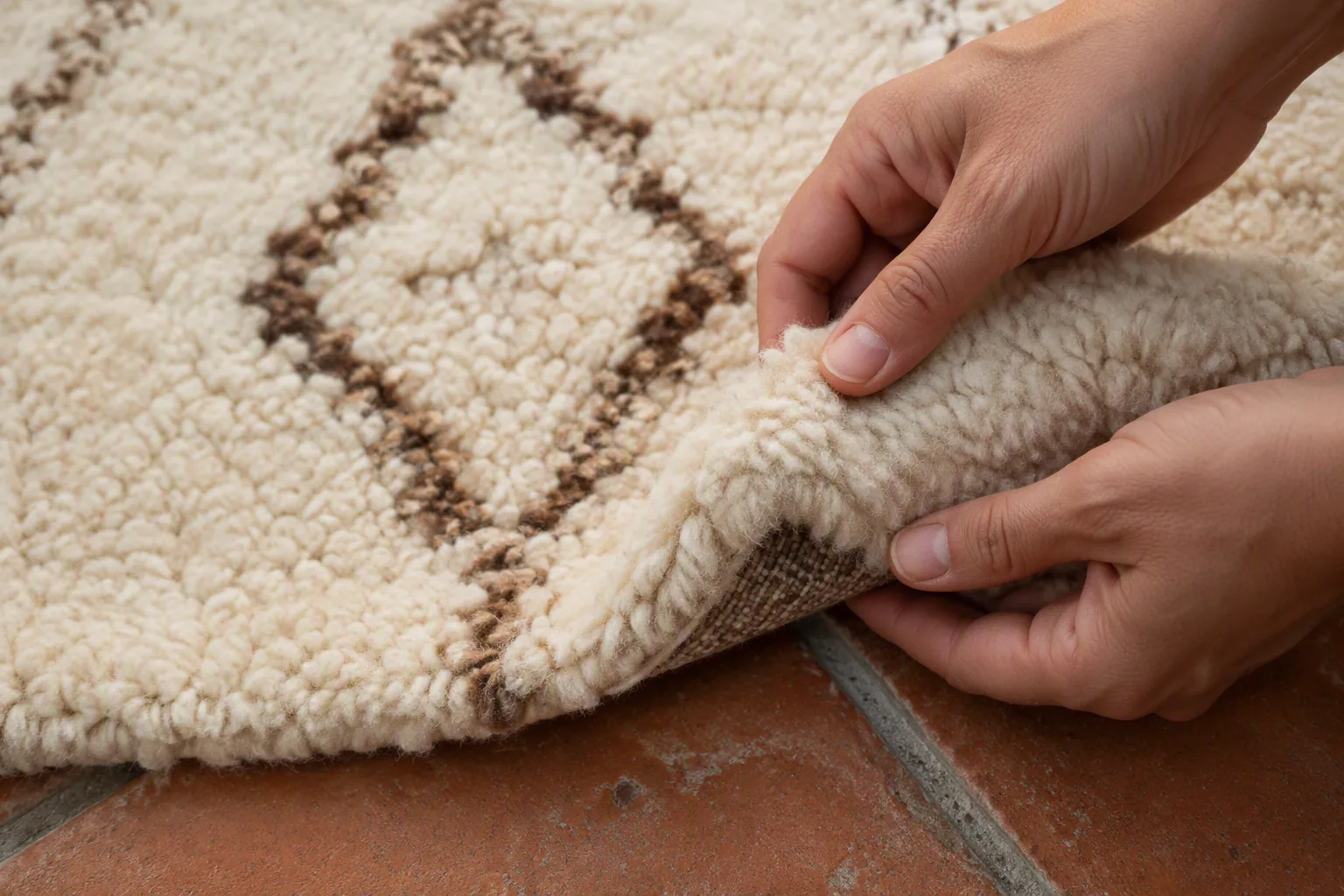
You don’t buy your rug where you learn its price. It is the only rule that really protects you. It points to one address for the first half of the job: the Ensemble Artisanal, avenue Mohammed V, the state gallery where crafts are sold at marked prices, with no touts. The rest plays out in the souk or in a cooperative, once you know what the wool is worth.
You still need to know it before you walk in. On our own souvenir list, the Berber rug is given at between 500 MAD and 2,000 MAD: that is the price of a small size or a flat weave, and it stops right at the moment the purchase gets serious.
You learn the price on avenue Mohammed V
Nobody goes up to avenue Mohammed V for a bargain. In these public outlets, prices are not the lowest on the market: they are fixed and checked, and quality standards are enforced. That is what makes them useful. Elsewhere, the same 2 × 3 m Beni Ourain sells for anywhere from one to three times the price depending on the stall. Half off the tripled price looks a lot like a win. How would you know it isn’t one?
So plan one visit without buying anything. Note two or three sizes, photograph the price tags, keep those figures for the souk.
The official label won’t follow you into the alley
Morocco’s Ministry of Handicrafts has registered 69 labels as collective certification marks, meant to ensure traceability, guarantee the product’s origin and quality, and help the consumer at the moment of purchase. Sworn inspectors and regional labeling units monitor their use. But these labels certify production units, not sellers. The ministry counts about 2,500 certified units, 750 of them for the national “Morocco Handmade” label.
In other words, in front of a pile of rugs in an alley, nobody will show you anything official. The label is a good sign when it’s there, never a method.
The back of the rug speaks more clearly than the seller
Turn the piece over. A hand-knotted rug shows clusters of individual knots on the back; a machine-made rug has a uniform back of fabric, canvas or latex, without a single visible knot. Then look at the fringe. On a genuine weave, it continues the warp threads and is part of the structure. On a fake, it is sewn on separately.
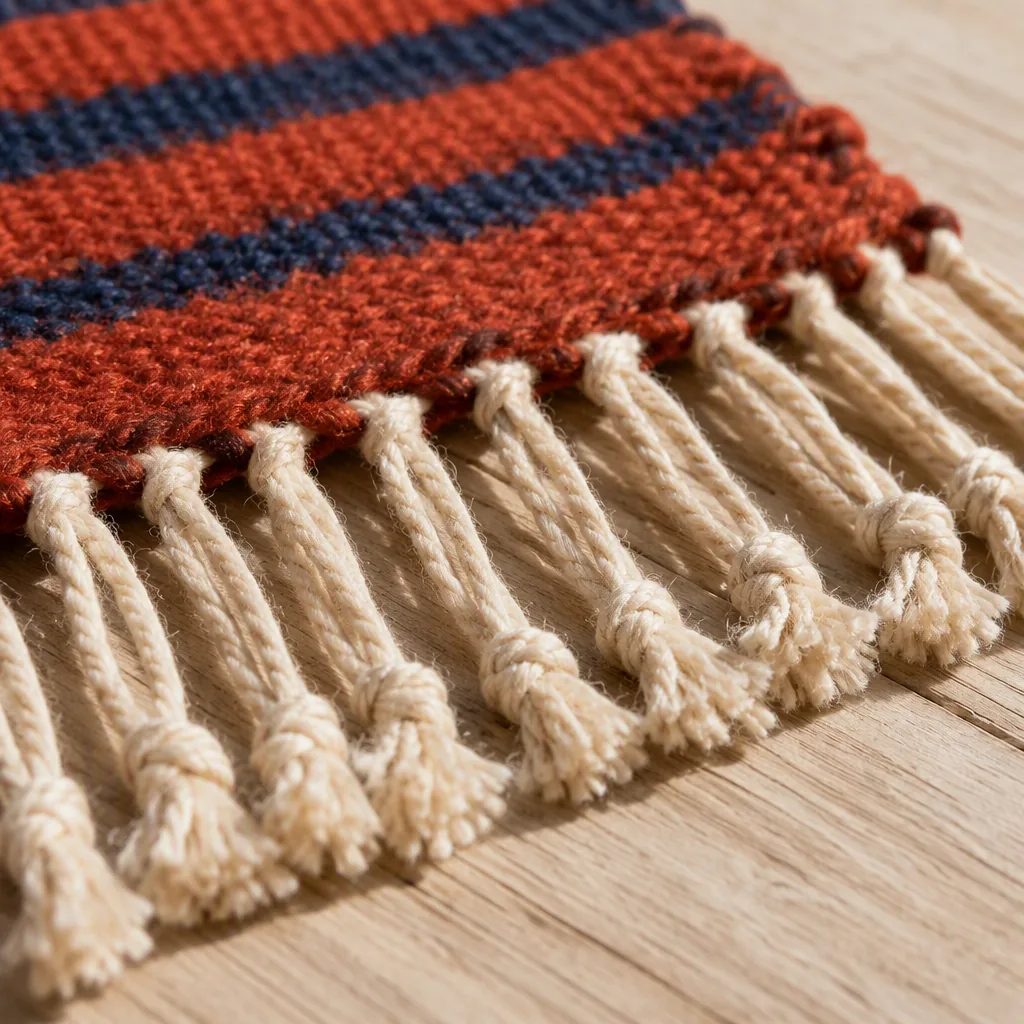
Both checks are done in silence and without asking permission. A merchant who trusts his goods lets you get on with it; another starts talking faster.
A story can’t be checked
“Antique.” “Collector’s piece.” “It was at my grandmother’s.” Most often, the rug presented this way is recent and its price has simply been inflated. The vocabulary costs nothing to the person using it.
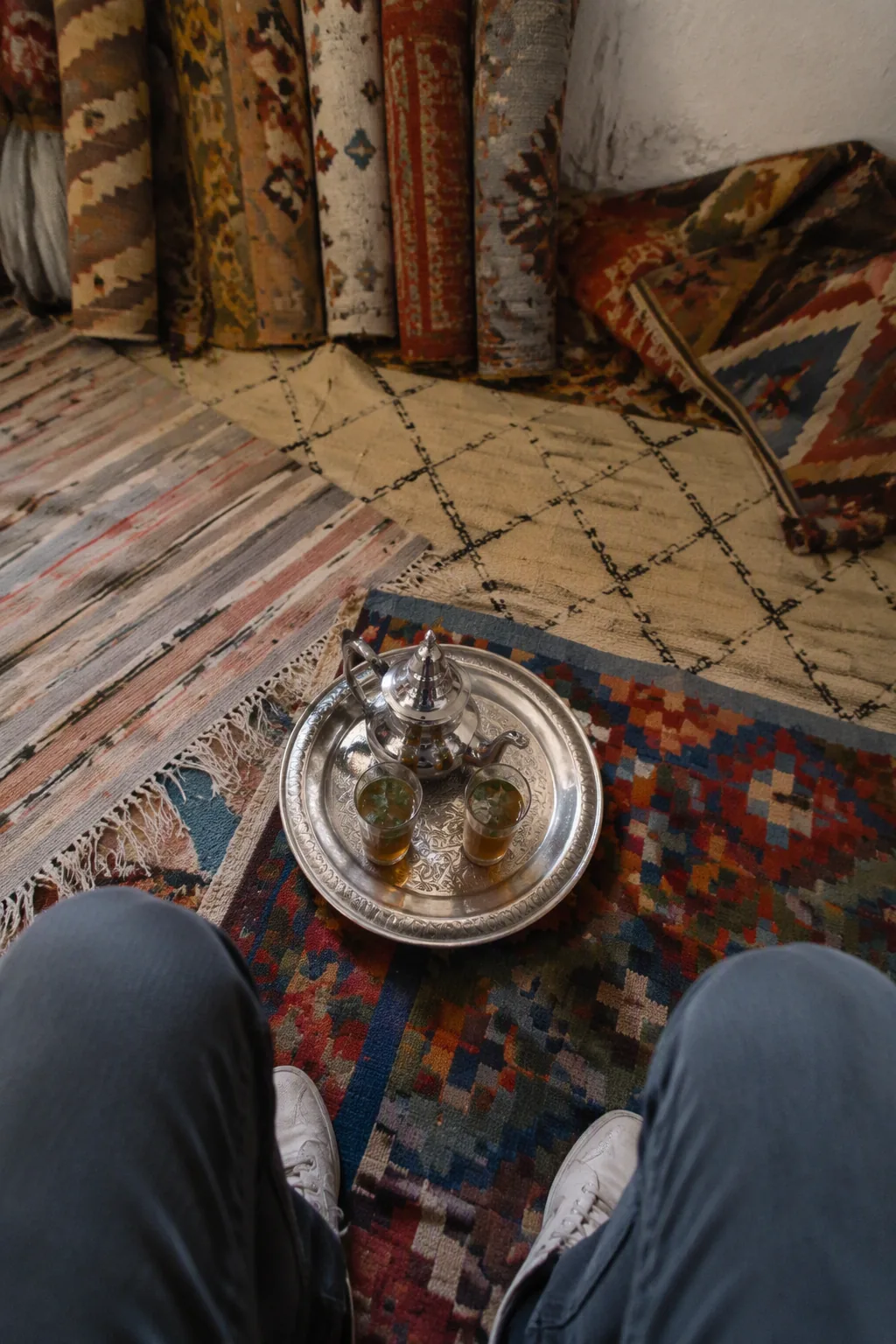
Take the story for what it is. If it’s true, it changes nothing about what you should pay. If it’s false, you have paid for a fiction at the price of wool.
The Beni Ourain plays on another scale
A small 60 × 120 cm kilim falls between 400 and 900 MAD. That is what the range describes in the list of souvenirs to bring back from Marrakech that we publish. The Beni Ourain climbs differently: 1,500 to 3,000 MAD for a small size, 3,000 to 6,000 MAD for a medium one, 6,000 to 15,000 MAD and beyond for large pieces. The gap is visible to the naked eye. A real 150 × 200 cm Beni Ourain in quality wool cannot sell for 1,000 MAD and still feed everyone in the chain. A price that is too low is not a bargain, it is a confession about the material.
On this point, our published page stops short of the question you are asking yourself.
Someone takes a commission on your purchase
The price you are quoted also pays the person who got you through the door. Whoever spontaneously offers you “a cooperative” or “the best workshop” takes a commission, added to your bill, with no guarantee of quality whatsoever. Our guide to safety in Marrakech for travelers comes at the problem from the other end and describes the wrong-direction variant: a stranger claims the way is closed, suggests another route, and that route ends in a shop.
When the word “cooperative” comes from someone who approached you, it means a commission rather than an address.
The real cooperatives are far from the center. Those in the Atlas Mountains sell directly to visitors, at prices that reflect actual production costs without the Marrakech markup, and post more transparent prices in exchange for an often narrower choice. It takes a day and a car. Staying in town remains a defensible trade-off: the souk gives you choice, the cooperative gives you calm.
In the souk, Zrabi is where you look. Our page on which souks to visit in Marrakech explains why that souk is not one to visit empty-handed. Before all that, there is a museum. Our Marrakech souks guide explains why an hour spent in front of documented rugs is worth more than an hour of haggling, and gives the opening hours and the entry fee.
The rug keeps costing after the shop
To pay, look at the card terminal before you take out your card. Our safety guide puts the fraud risk a notch higher in small shops with old terminals and recommends cash when in doubt. Also keep the receipts for your withdrawals: since the dirham is a closed currency, the airport converts whatever you have left back on presentation of them.
To ship a large piece, insist on a written quote rather than a promise. The receipt must state the dimensions, the material and the agreed price before the rug leaves the shop, and shipping adds between 15 and 25% to the total cost. Do this math before you negotiate: a rug whose shipping you hadn’t planned for often ends up costing more than the one you ruled out for its price.
Then there is customs, which nobody mentions in the souks. French customs has the final say: it grants a duty-free allowance of 430 euros in value to travelers aged 15 or over arriving by air or sea, 300 euros by any other means of transport, 150 euros under 15, and above that the goods must be declared, with VAT and duties on top. The amounts cannot be combined on a single item. So two travelers cannot pool their allowances for one rug. Large Beni Ourain rugs exceed this limit without the slightest ambiguity. Convert the price while you are still in the shop.
Leave without having named a figure
Here, haggling “just to see” and then walking away counts as the only real faux pas. It is a rule of courtesy, and we think it is fair. As long as you haven’t named any amount, leaving the shop wrongs no one. Getting someone to come down at length and then slipping away is something else.
Look, turn it over, ask the price, say thank you. The first number you say commits you far more than you think.
What we would do in your place
Most travelers will go home better off without a rug, and we are willing to say so in writing. The gap between a small size and a large piece runs to thousands of dirhams, and it comes down to a material you learn to recognize over several visits. One afternoon is not enough. A kilim brought home without regret is worth more than a Beni Ourain bought under pressure, and it fits in the suitcase.
If you still want one (and many do, it is a lovely thing to bring back), do it on your second pass, with the photos from avenue Mohammed V on your phone and the written quote in your pocket.
And when you are told the price won’t hold until tomorrow, you will already know what to make of it.