



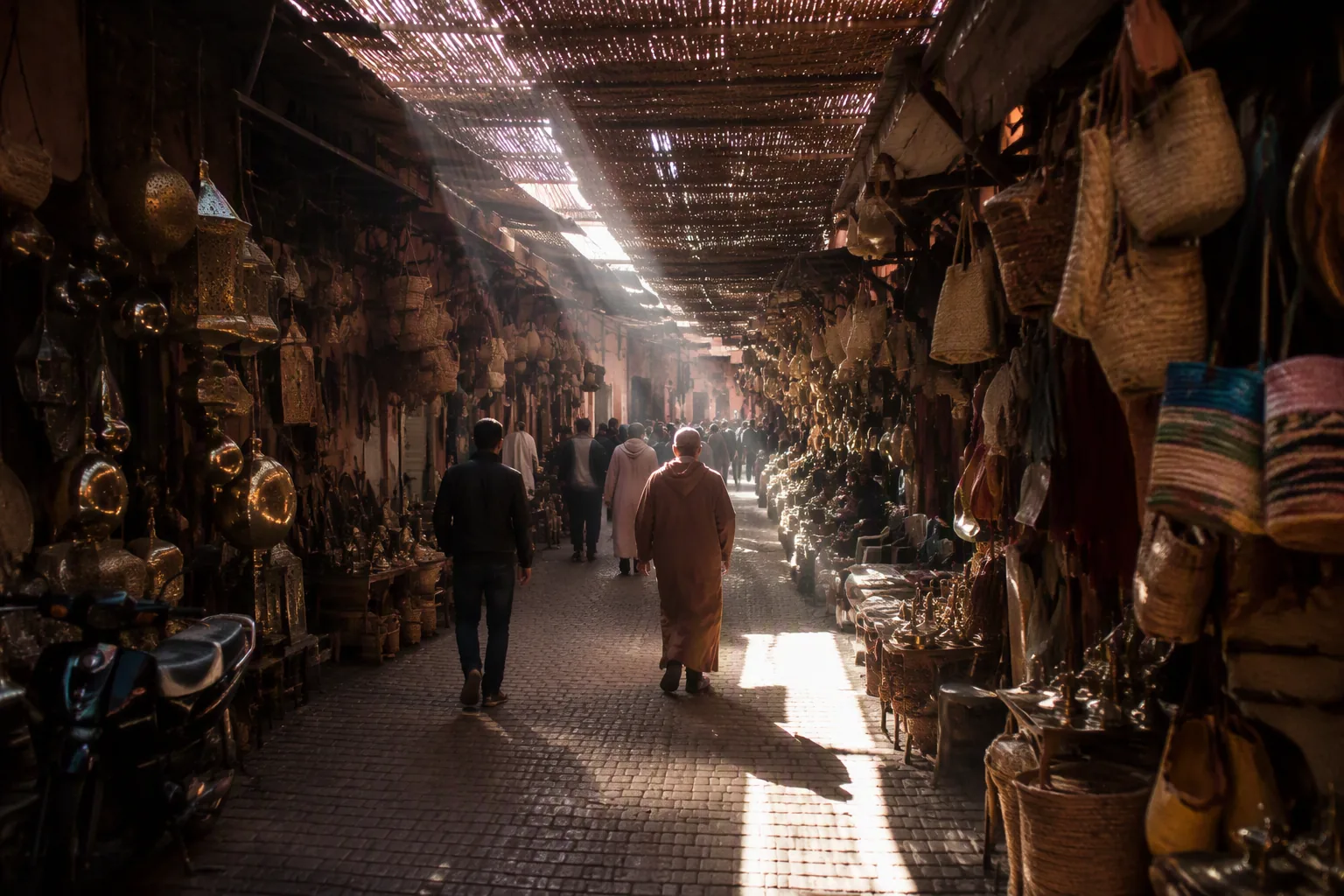
For a first visit, four trades are enough: spices at Rahba Kedima, leather in the Cherratin souk, lanterns in the Haddadine souk, babouches in the Smata souk. The rest you discover as you walk. Nobody visits them all anyway. Trying to tick off every alley is the best way to come home tired, with photos that all look alike.
Souk names lie a little, the stalls never do
The Moroccan National Tourist Office (ONMT) presents Semmarine as “perhaps one of the most interesting in Morocco”, where Amazigh and Arab crafts meet, and ties the Attarine souk to copperwork. Elsewhere, the same Attarine is assigned to spices, and Semmarine to textiles. Both versions circulate. Neither can be checked from home.
Hence the only rule that holds on the ground: trust the trade in front of your eyes, not the name you read the night before.
The rest of the layout is more stable. Silver jewelry sits around Semmarine, rugs in the Zrabi souk, tagines at the Mellah market. Which ones deserve your morning, and which are only worth the detour if you are buying: we go through it souk by souk in which souks to visit in Marrakech.
Go in, wander, come back out
Our guide to what to visit in Marrakech suggests entering by the Koutoubia and keeping it as a landmark, allowing yourself to get lost for a quarter of an hour, then heading back to a known street such as Semmarine or Mouassine. The minaret helps: it rises to 77 m and stays visible from far away.
So does Jemaa el-Fna. It is signposted everywhere in the alleys, and shopkeepers often point you back to it without you asking anything. Pick a general direction and stick to it. If the fear of getting lost is holding you back, first read how to see the souks without going in circles.
The souks open every day, usually from morning to early evening. Morning is still the best time: fewer people, and sellers with more time to chat.
Carry cash: cards work in museums and the big restaurants, much less in the stalls. Light pants are better than shorts for a day in the souks. The neighborhood-by-neighborhood detail is in our guide on how to dress in Marrakech.
What deserves room in your suitcase
Look at the seller before the object. If they can tell you what it is made of, where, and by whom, you are probably looking at craftwork. Seeing the artisan at work on the spot is still the best guarantee.
The safe bets fit in a backpack: spices from 20 MAD per 100 g, a pair of babouches between 80 and 200 MAD, a lantern or a piece of silver jewelry from 100 MAD, argan oil from 50 MAD per 100 ml.
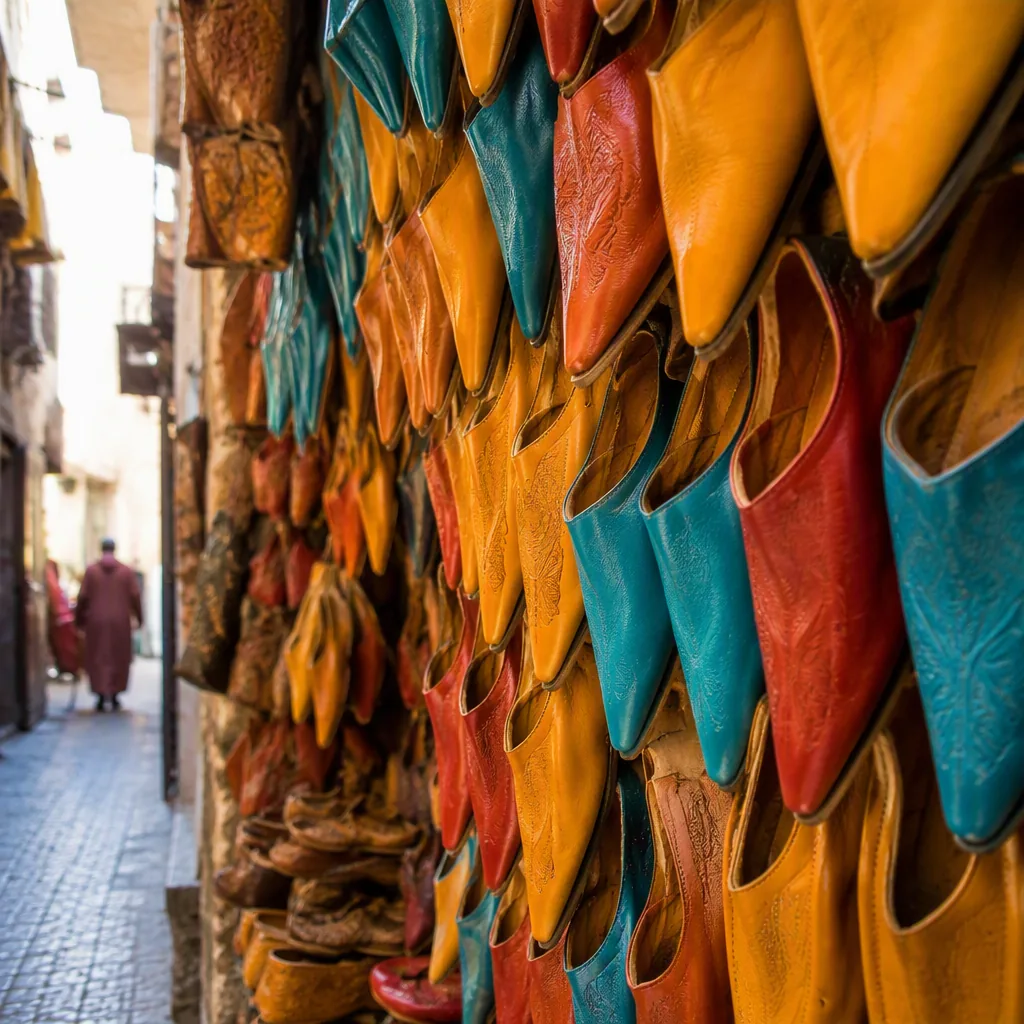
Leather, on the other hand, is judged by hand. Supple, natural smell, even stitching: it’s good. Too shiny, it’s often synthetic. Count on 150 MAD and up.
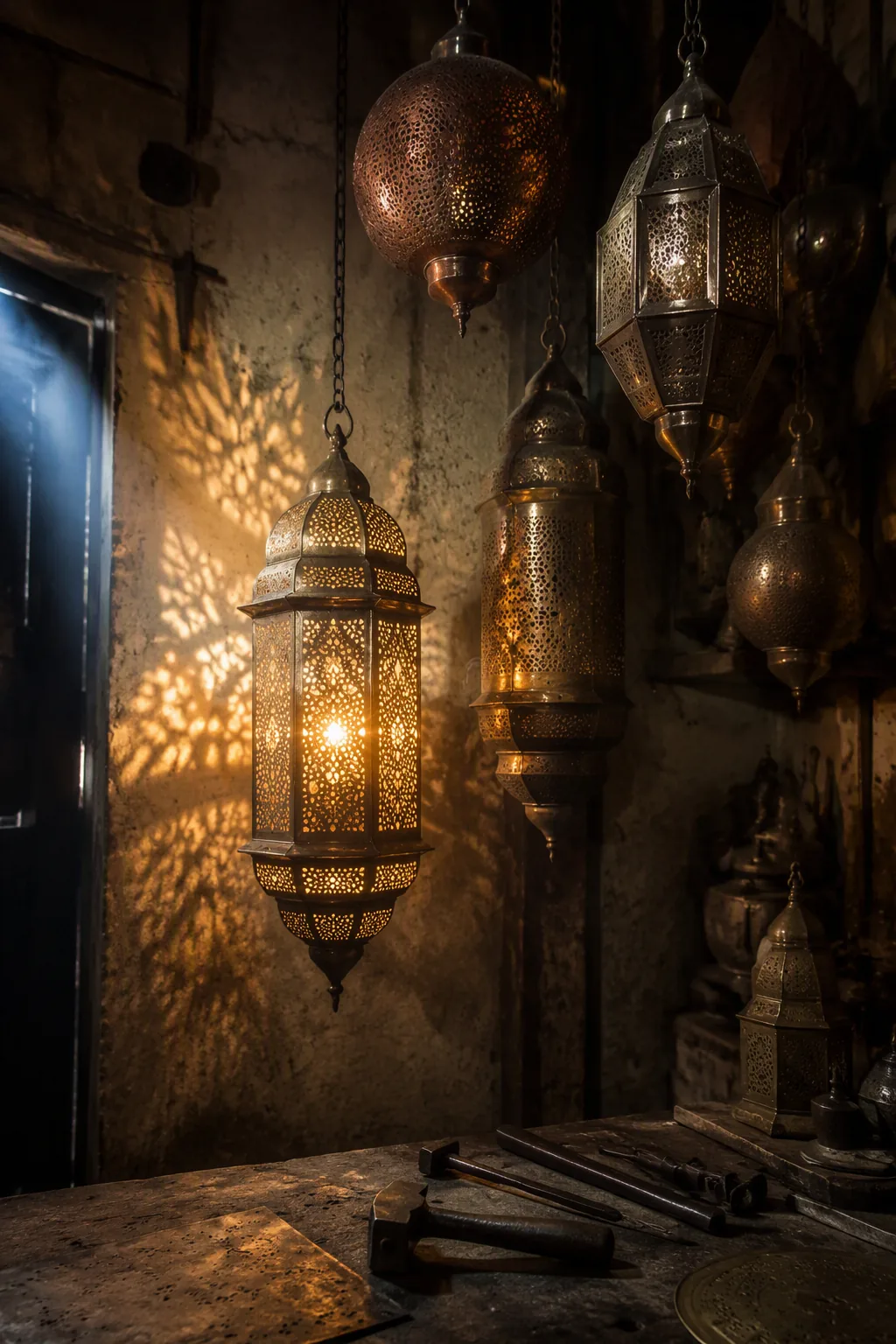
And what do you leave on the stall? Anything that exists in a hundred identical copies, with nobody to tell you how it was made. To sort the Moroccan from the generic, material by material, see which souvenirs are really Moroccan. Item by item, our list of souvenirs to bring back from Marrakech sorts through it all in detail.
The rug, the one purchase worth coming back for the next day
A Berber rug runs between 500 and 2,000 MAD, and the Zrabi souk is where to look for one. At these amounts, an impulse buy costs you. Wool, knotting, shipping and customs have their own page: where to buy a rug without getting ripped off.
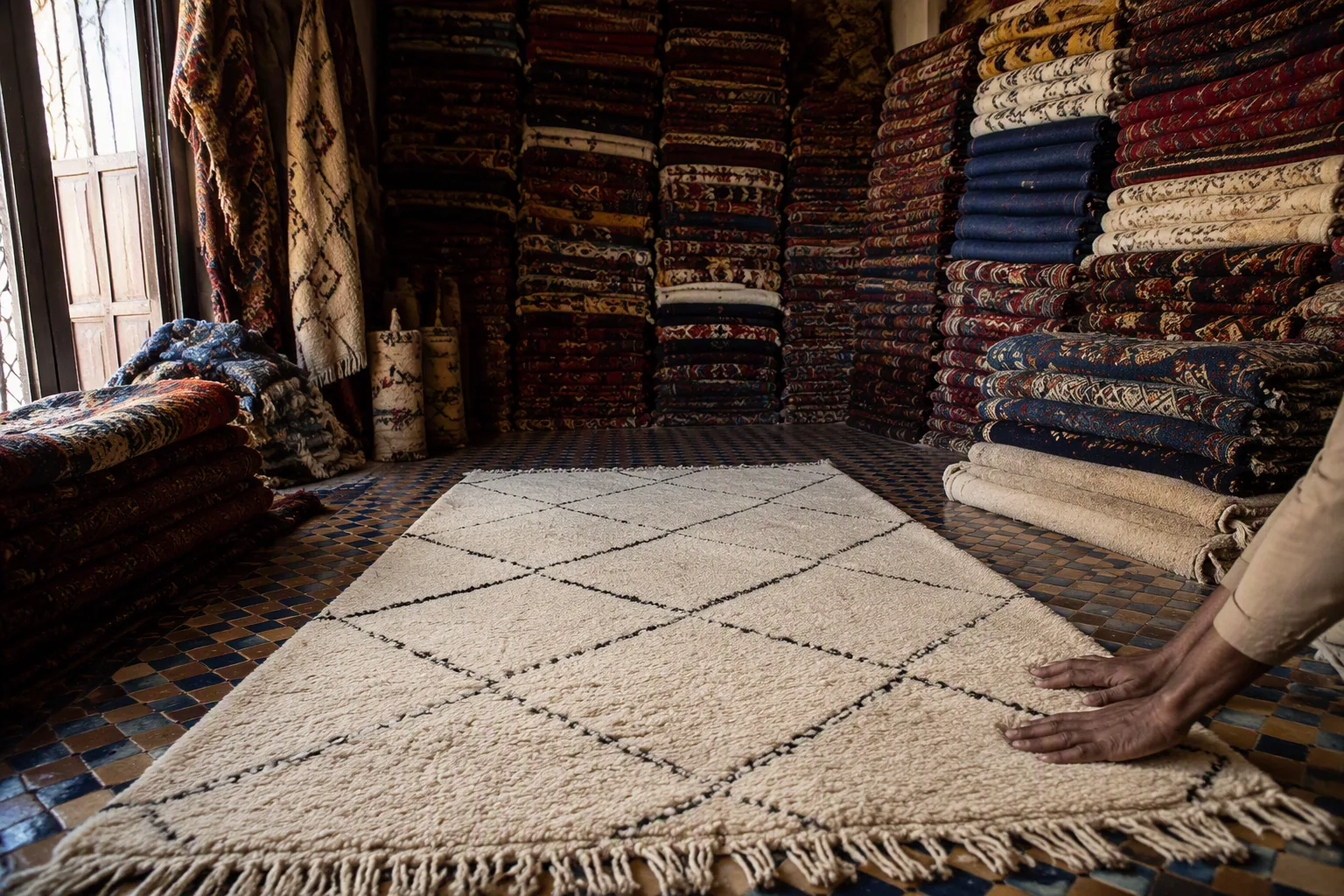
We recommend a visit beforehand: Dar Si Saïd. Our guide to the must-sees presents it as the National Museum of Weaving and Carpets, and that is indeed its official name today. Yet you still read, here and there, that it is devoted to woodwork. Its collection of Moroccan rugs and weavings, for its part, is documented region by region, from Tensift to Tafilalet.
Admission is 30 DH for an adult. The museum is open Tuesday to Sunday, from 10:00 to 18:00, and closed on Monday.
Go there before the stalls. You never look at a pile of rugs the same way once you have seen what the wool and the knot can tell you.
The trap comes before the price. It is the very helpful stranger who offers to show you the way and drops you off at a shop. Turn him down from the first word, politely, saying you know the way. If street approaches worry you more broadly, read our page on safety in Marrakech for travelers.
Haggling: our two guides don’t say the same thing
Our souvenir list advises starting at about half the asking price; our must-sees guide aims more for 40 to 60%. The exact figure matters little. What decides it is the reference price you have in mind when you arrive.
Ask several sellers the price of the same object before committing to anything, and ask your riad what the going rate is right now. On leather, a 30 to 50% discount is common. On babouches, it is the number of pairs that moves the price, not eloquence.
The price doesn’t suit you? Smile, say thank you, walk away. Nobody takes offense.
And if haggling wears you out, not everything is negotiated here: in the big chain stores of Guéliz, the ONMT points out, haggling over prices is no longer the practice.
Don’t buy spices or perfumes on the Jemaa el-Fna square itself, it costs more than two alleys away. A haggling session, line by line, is laid out in how to haggle in the souks.
What we take away from it
The souks don’t work as a checklist. Buy little, slowly, and look at the rest without taking out your wallet. A pair of babouches chosen while talking with the man who stitched them will tell you more, ten years from now, than a suitcase filled in a hurry on the last morning.