




Rahba Kedima, Haddadine and Semmarine can be visited empty-handed. Cherratin, Smata and Zrabi are shops first, and are worth the detour only if you already know what you’re looking for. The difference between the two shows before you’ve even asked a price.
You’ll hear plenty of other names. Ruling them out takes more work than listing them.
Rahba Kedima, Haddadine, Semmarine
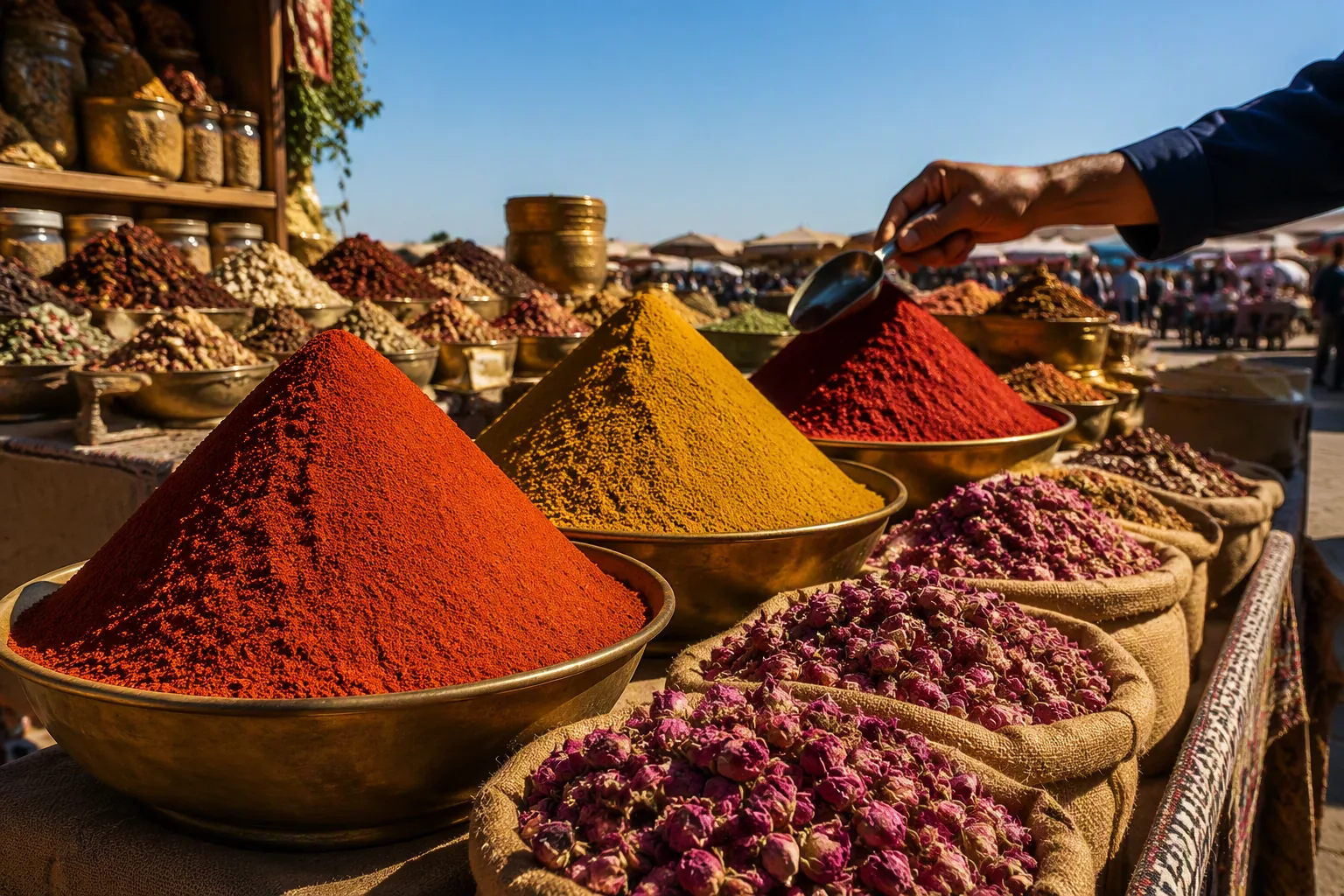
Rahba Kedima asks nothing of you. You look, you leave, and that already counts as a visit. The spices are piled into cones, bright red saffron, golden cumin, vivid paprika, and prices start at 20 MAD per 100 g. It’s also the least committing purchase in the area. If you want to try haggling for real, do it here, not in front of a carpet.
Haddadine, near the Ben Youssef madrasa, is the souk of copper and brass lanterns, pierced with delicate patterns, from 100 MAD. Lift one before you start dreaming. The weight and bulk usually become clear too late, once the suitcase is open.
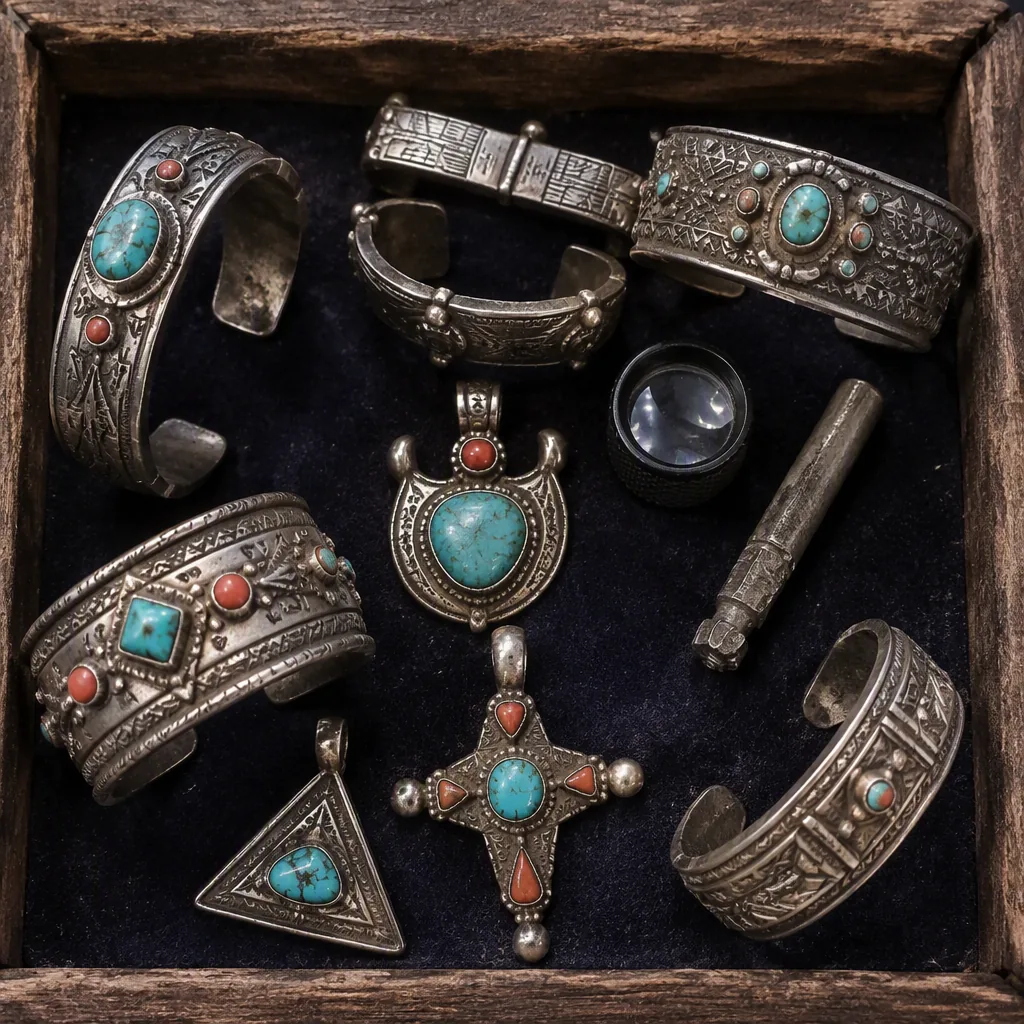
Semmarine is the covered main street that almost nobody gets around, and its stalls mix ornate candles, pottery and light fixtures. Silver shines here too: bracelets, pendants, earrings inlaid with turquoise, from 100 MAD, always asking for the hallmark. It’s the most general of the three. People linger mostly because it’s the first thing they see. To see real workshops still in business, look instead around Dar Si Saïd.
The three souks that are really shops
Cherratin is leather: bags, belts, poufs, wallets, from 150 MAD. If you don’t mean to buy, you won’t see much there that the other alleys don’t already show you.
Smata lines whole walls with babouches, from 80 to 200 MAD depending on quality. Why keep it among the useful stops when people go there to buy? The hand-stitched pair softens to your foot and lasts for years, while the factory version stays stiff and smells of plastic. Pick up one of each. You’ll have learned, on the spot, a test that works everywhere else.
The Zrabi souk is the carpet souk, from 500 to 2,000 MAD. At that level, nobody decides while walking past.
For haggling and for carpets, continue with the Marrakech souks guide. Starting prices, item by item, are in our list of souvenirs to bring back from Marrakech.
The only one we frankly advise against
The tanners’ and dyers’ souk gives pride of place to leather of every kind; babouches and leather goods fill alleys steeped in the heady smell of hides tanned in the sun.
It’s not the smell that makes us cross it off the list.
It’s that it serves as the end point of the most common scam in the medina. Someone sees you hesitate, walks up, offers to guide you. Three alleys later the tone changes, and the walk ends at a cousin’s tannery. Fake guides are most insistent near Jemaa el-Fna, and then demand 50 to 100 dirhams. You’ll find the same leather in Cherratin, at the same price, without having followed anyone.
We lay out the full pattern and its variations in our guide to safety in Marrakech.
And all the others?
A good share of the souks has nothing to do with you, and there’s nothing odd about that. They also sell the neighborhood’s everyday goods, the corner grocery included. Ahiak, for example, sells clothes: T-shirts, jeans, dresses, traditional outfits. Nothing to look for there unless you live nearby.
One exception is worth the detour, and it rarely gets mentioned: the Mellah market, where colorful tagines line up by the dozen, from 120 MAD. As a bonus, the neighborhood has quieter alleys to catch your breath between two visits, a point also made in our Marrakech must-sees.
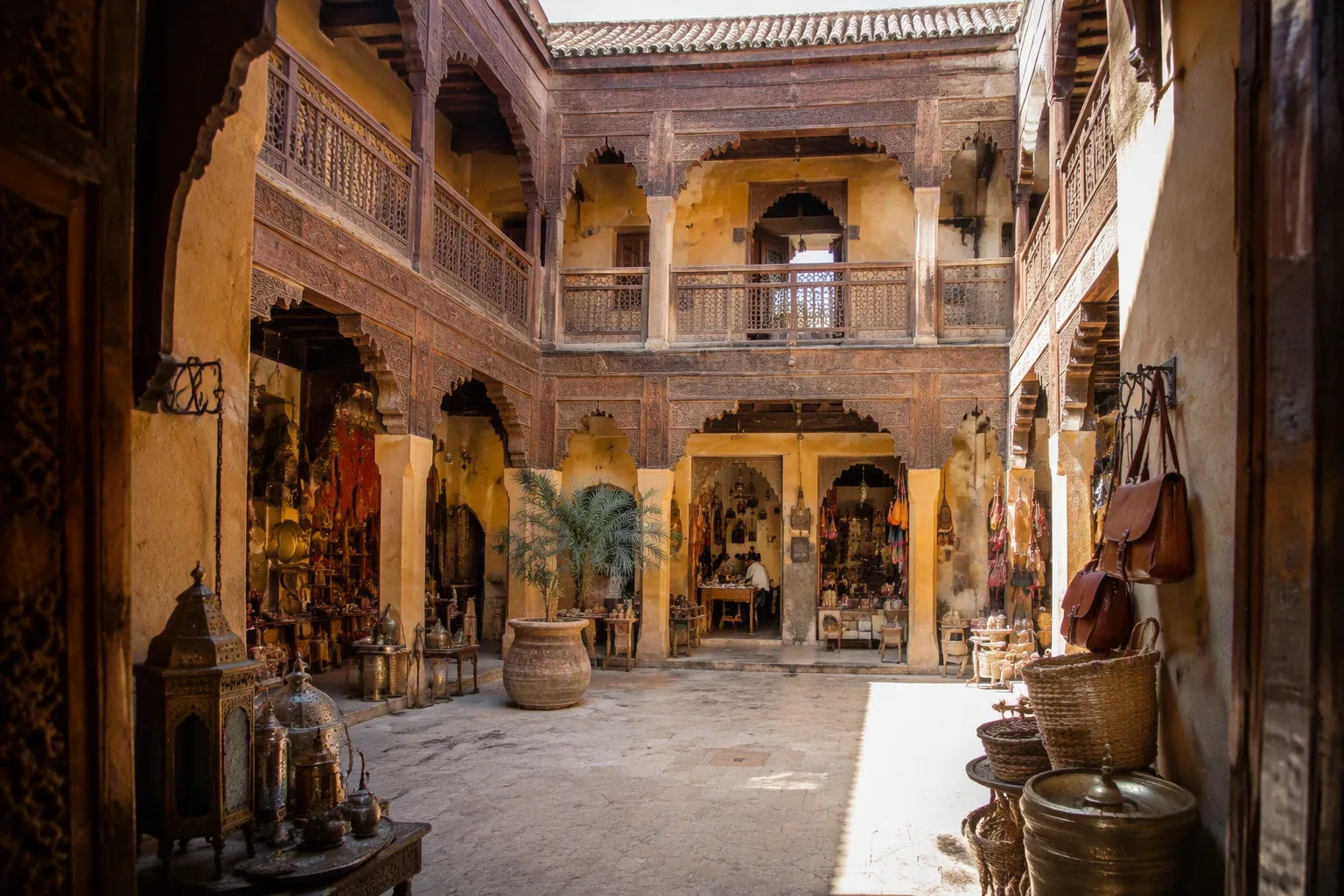
Keep an eye on open doorways along the way, too. Some lead into a fondouk, an inner courtyard ringed with small shops, which once served as an inn for travelers and today extends the souk without any hint of it from the street.
Why we don’t give an itinerary
The souks are a maze, and the useful reflex is to keep a mosque or a large square in mind. A fixed route assumes you turn where you planned to. Once there, that rarely happens.
So what we give is an order of priority. Rahba Kedima first, because that’s where people stop. Haddadine next. Semmarine, you’ll pass through without looking for it.
When to go, and for how long
The right window is narrow: between 9:30 and 11 a.m., before the groups and the worst of the heat. Earlier is pointless. At dawn, the alleys are lined with nothing but small closed wooden doors. Allow 2 to 3 hours to walk without rushing.
Beyond that, you look without seeing.
If your morning is taken, closing time comes around 9-10 p.m., which leaves a real window at the end of the day. Except in July and August. Temperatures regularly top 38 °C between 11 a.m. and 5 p.m., the narrow alleys trap the heat, and many souks offer no escape. Our page on when to go to Marrakech sets out, month by month, what each period is worth.
Who should skip it
With a stroller, or young children on foot, frankly no. You have to weave through the crowd, dodge a scooter speeding past, a van, a cart pulled by someone.
If sales pitches wear you out, you can leave the tank top at the riad, since a sleeveless top in the souks draws a little more solicitation.
And if haggling makes you tense, you don’t have to go at all. Fixed-price shops exist: the souk is not a must.
Going back a second time
Plan two short visits rather than one long one. The first is for looking and comparing prices, the second for buying. It’s also what keeps you from coming home with an object you won’t know what to do with.