




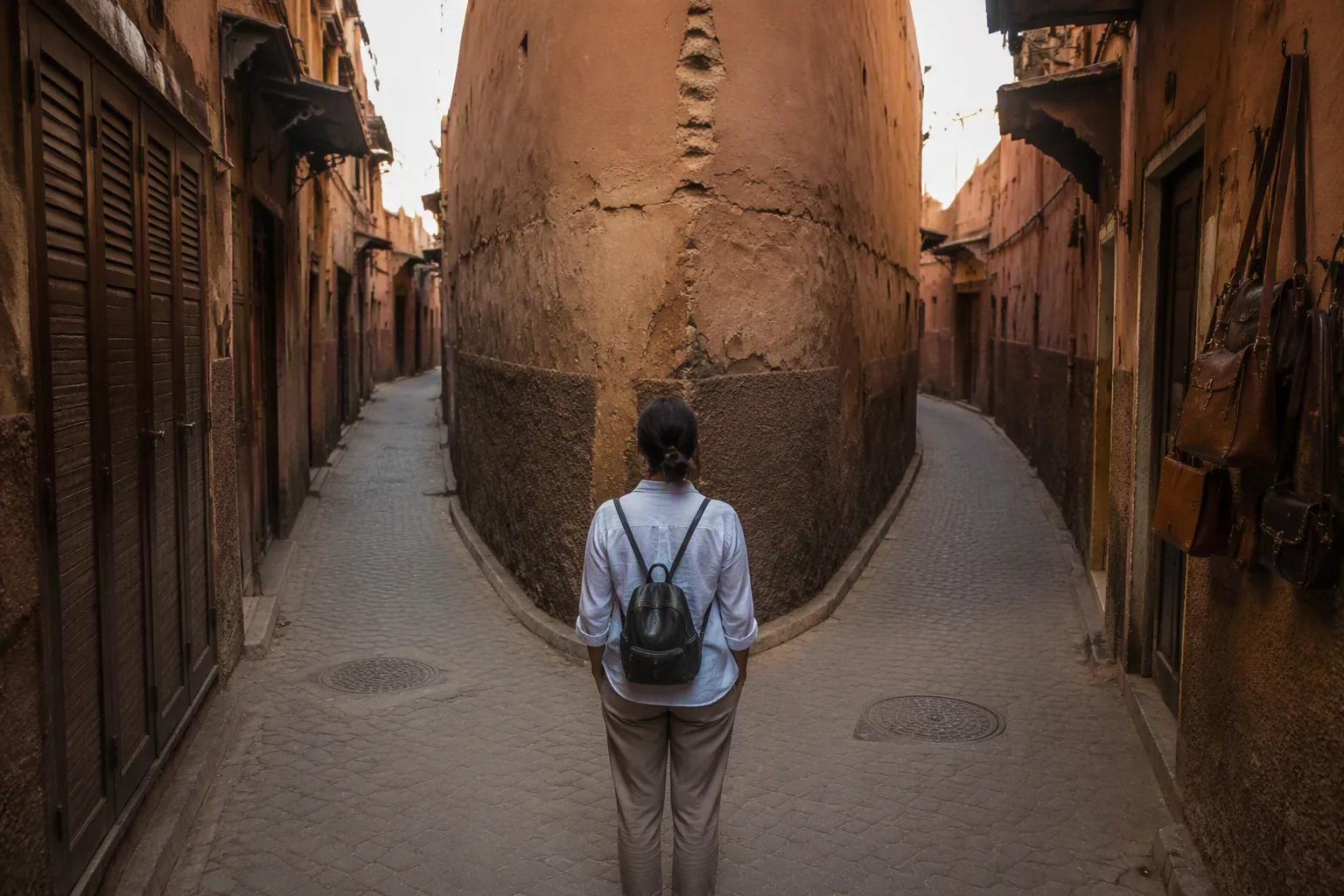
Walk one main street north, then walk back down it. It’s called Semmarine, it starts at Jemaa el-Fna, and it’s the backbone of the whole district. That’s the entire method, and it works because a there-and-back route never closes in on itself.
Which gate to get dropped at
Taxis don’t enter the medina. The alleys are too narrow for cars, so you get dropped at the gates: Bab Doukkala, the Koutoubia or Jemaa el-Fna, depending on your riad’s address. If it isn’t Jemaa el-Fna, you have a decision to make on day one, and the decision is to walk to the square anyway. Turn your back on the Koutoubia, head due north, and two minutes later you’re at the entrance to Semmarine.
Diving straight in through the nearest gate saves you some walking. You pay for it at the end of the day, when nothing around you looks like the place you came in by.
Two landmarks are enough
The first is a direction. Jemaa el-Fna square is always south of the souks, and that holds wherever you’ve wandered off to. The second you see by looking up. Minarets rise above the roofs and give you a pointer when the alleys give you none; the Koutoubia’s stands southwest of the square.
Other methods exist, the big gates and the squares that mark out the ground. They’re sound, and that’s already a lot to ask of a head worn out by the heat.
Don’t count on signs. There are no clear ones, the districts blend into one another, and it takes about thirty minutes of walking before you get a feel for the logic. Many alleys simply have no name.
Once the main street is under your feet
A simple route starts at the square, goes up Semmarine due north, passes through the Rahba Kedima and ends at the Ben Youssef medersa: about 2.5 km, two hours without rushing. One hour is enough if you stay around the square, half a day if you add the palaces to the south. Finding Semmarine again means finding the way out. Hence the U-turn rather than the loop: a loop asks you to recognize an exit you’ve never seen, a U-turn only asks you to turn around. The way in has left far more landmarks in your head than you realize. A main axis doesn’t tell you where to turn; it tells you how to get back.
What each alley sells is another matter, and our page on which souks to visit in Marrakech sorts the souks you walk through without buying anything from the ones you enter only to buy. If there’s one reason to leave the main street for a whole afternoon, it’s a rug: where to buy a rug without getting ripped off.
Your phone under the roofs
GPS often loses the thread in the covered alleys. Downloading an offline map is still useful, and GPS works even without a network. What blocks it here is the roofs. Elsewhere on the site, we advise memorizing the route for a few minutes rather than following the screen as you walk. That advice, in fact, has less to do with finding your way than with the alley itself: in heavy-traffic areas, the phone stays close to your body, in a closed hand or in a pocket.
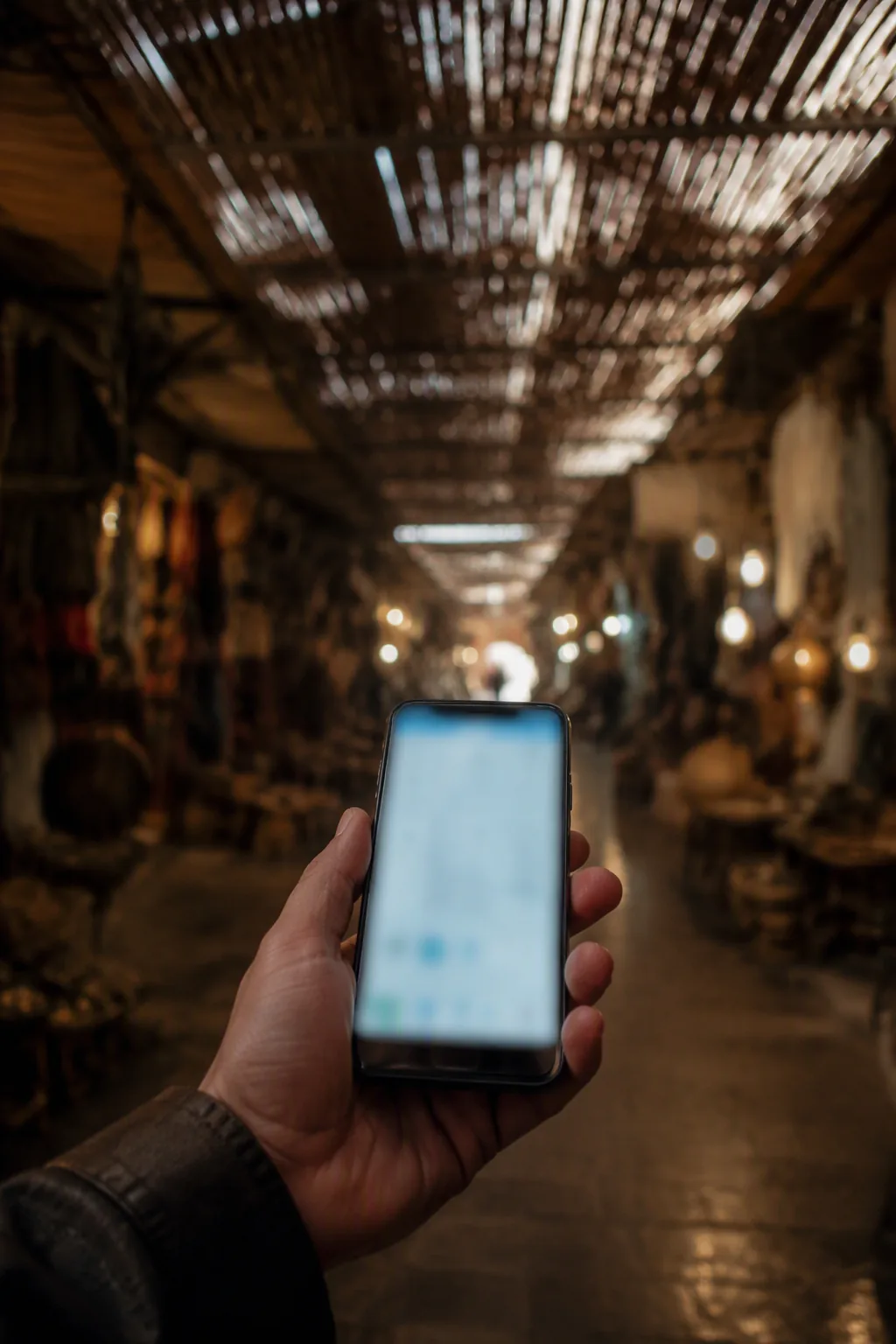
There’s a smarter use for the map before you go in. Pin a landmark café on it, somewhere to catch your breath if the crowd overwhelms you.
Lost for good
Keep walking. Jemaa el-Fna square is never closed, and the souks don’t close off access to people on foot. Then ask someone who is sitting down. A shopkeeper settled in his spot points the way without getting up, and “Jemaa el-Fna?”, pronounced more or less correctly, is usually enough to get a pointed finger. Walking into a café or a riad and asking at the counter works just as well. Showing your riad’s card saves half the conversation.
None of this lasts long, anyway. From the square, allow about ten minutes on foot to the Kasbah, about forty to Guéliz.
Because the ones who hesitate get approached
The fake guide’s approach is set off by a precise signal: someone stops in the middle of an alley, head up, looking around. The offer is always free and spontaneous, and the switch comes once you’re far from your starting point and feel psychologically indebted. Your hesitation supplies the raw material. The lines used to build on it repeat from one alley to the next: “it’s closed that way”, “the square is on the other side”, “today is the Berber festival”.
Two moves are enough to cut it short. Never follow someone you didn’t ask, and say “la shukran” without slowing down. There are plenty of variations, and we’ve gathered them on our page about safety in Marrakech.
If you’d rather pay someone
What you buy with a guide is a medersa that stops being just a pretty courtyard. The direction of south, you already have.
How do you recognize an official guide? The license comes from the Moroccan Ministry of Tourism. A real guide carries a card, and is paid in advance, at an agreed rate. Book from your riad, before you go in. The one who approaches you at the entrance to the souk has, by definition, agreed nothing at all.
When getting lost stops being fun
Everyone will tell you to get lost, and so do we: our must-see sights in Marrakech allow a quarter of an hour of wandering, as long as you then get back to a street you recognize. That quarter of an hour is a budget, not an open invitation.
What you bring back from these alleys, and at what price, isn’t decided while walking: that’s the subject of our guide to the Marrakech souks.
Getting lost stays fun as long as getting out is a decision. When it becomes a question, there’s no point checking one more alley: find the main street again and walk back down it.