




A generic souvenir is an object nobody behind the stall can place, neither the town nor the trade. Leather, hammered copper, wrought iron and woven wicker are made in Marrakech itself; thuya comes from Essaouira, and silver mostly from the South, from Tiznit to Goulimine. All of them are Moroccan.
So a Tiznit bracelet sold in the medina is nothing fake. A bracelet the seller knows nothing about is.
For the list of what to buy, the souks to find it in and the starting prices, see our guide to what to bring back from Marrakech.
“Handmade”, labels and tags
“Handmade” is what the seller says. Nobody checks it for you, and the phrase says little anyway: Moroccan crafts are worked by hand with machines and tools that have remained largely traditional. A machine in the workshop doesn’t make an object suspect.
What can be checked is a mark put there by someone other than the seller. Morocco’s National Crafts Label, “Morocco Handmade”, is an official three-level guarantee mark that judges the product and also the unit that makes it. Its directory of labeled units is public, cooperative by cooperative, from weaving to thuya by way of copper and leather. So a cooperative’s name on a tag can be checked before you pay. Don’t expect to see it at every stall, though, and don’t hold its absence against the seller. Its consumer page announces 350 labeled units since its launch in 2013. Other official figures, higher ones, are in circulation: our page on rugs covers them. The counts don’t match, and we would rather say so than pick one.
Under the “Maroc fait main” umbrella brand, one of the five labels is called “Artisanat Régional” and serves to distinguish local products. That is the one to look for on a tag.
Leather, copper, iron, clay and wicker
You can watch these trades at work in the city. Marrakech’s tanners make babouches, bags and living-room items; coppersmiths work copper and brass here, wrought iron gives lanterns and mirrors, and wicker, raffia and palm are woven here as in Fez or Salé. Pottery has its Potters’ Hill, where generations of craftsmen shape utilitarian pieces as well as decorative objects.
For these objects, the advice in our Marrakech souks guide holds without reservation: the workshop exists, and often a few steps from the shop. Ask to see it. A seller who has one has no reason to refuse.
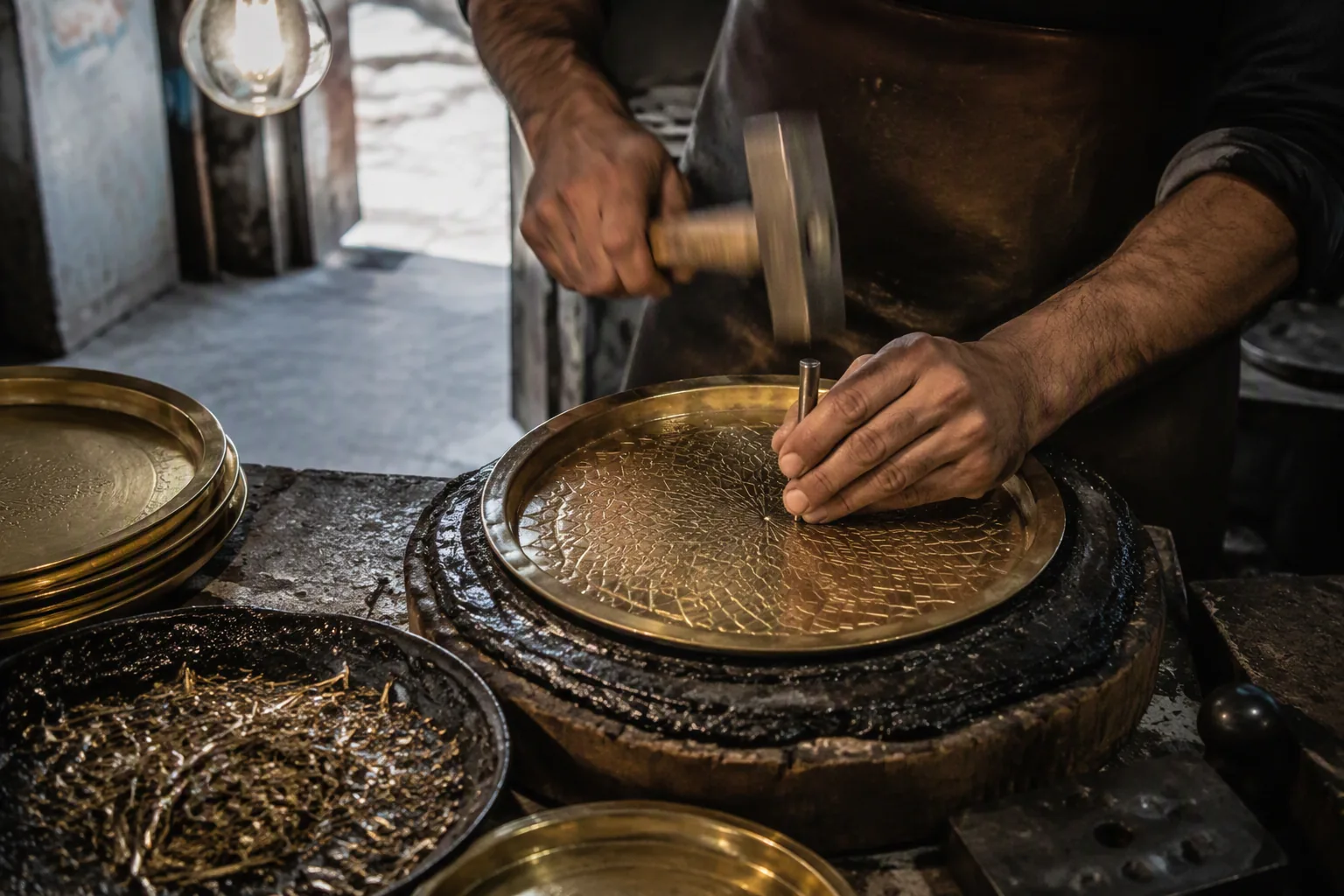
A hand-hammered copper tray keeps uneven facets right under the rim. Run your finger over them, then over the decoration: chased, a pattern has relief; stamped, it stays flat and repeats identically from one piece to the next.
For babouches, the test for a factory-made pair is explained on our page about the souks to visit in Marrakech.
Terracotta mostly raises a question of use. For cooking, our souvenir guide recommends a lead-free terracotta tagine, and keeps hand-painted patterns for decoration. A decorated tagine bought for the oven is an authentic object badly chosen. The colors, for their part, place the piece: blue for Fez, yellow for Safi, green for Meknes. A Safi plate sold in Marrakech is perfectly honest.
Basketry seems too humble to copy. It gets copied all the same. The state went to court to protect Taza-Taounate basketry, as it did Fez zellige, and Law No. 133-12 opened geographical indications to craft products for the first time. The sector’s labeling strategy names, in black and white, what it is fighting: lack of traceability, counterfeiting, unfair competition. Asking where a basket comes from is no tourist whim.
Silver and thuya
Two materials are Moroccan without being from Marrakech.
Much silver jewelry is made in Goulimine, Agadir, Essaouira, Tiznit or Taroudant, then sold in the souks of the old medinas. Our souvenir guide also points to real workshops still active around Dar Si Saïd. A fibula on a stall may have come by either route. Ask which.
The same guide advises asking for the hallmark. Do it, knowing what it says. In Morocco, silver articles subject to control go through a customs assay office, and the mark indicates the metal and its legal fineness: for silver, a cow’s head with the number 1 or 2. It certifies neither the quality of the workmanship, nor the origin, nor the age. Pieces of one gram or less are exempt, which explains why a very small earring carries none.
Our guide also writes that each piece is unique, shaped by hand. That is true of jewelry from a workshop. Not of everything that glitters on a stall, and the hallmark will never tell the difference for you.
Thuya comes from Essaouira. The wood marquetry is after is the burl, the growth at the base of the trunk, particularly in this region. It is what draws the swirling veins of the fine boxes. And it is what the Moroccan market concentrates on, to the point of driving deforestation of the species.
An object can be perfectly authentic and cost a tree dearly. Our advice: little thuya, and small. If this wood matters to you, wait for Essaouira and a workshop that will tell you what it works with.
Argan
Argan is unusual in that its name is legally reserved. The Moroccan Office of Industrial and Commercial Property lists argan oil from the Souss Massa Draa region among geographical indications, and spells out the scope: the law bars the name “Argan” to producers outside the zone, and to those inside it who do not follow the specifications.
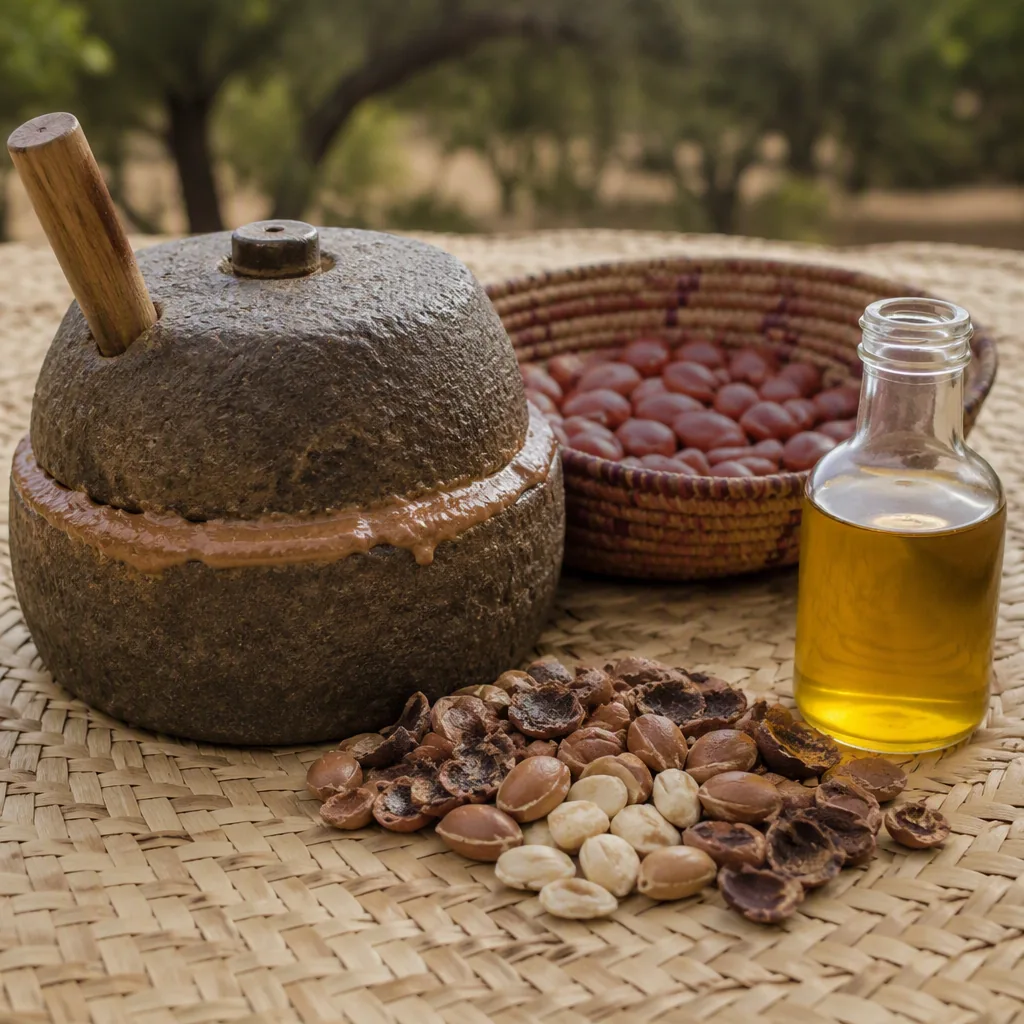
That right stops where the unlabeled bottle begins. Filled in front of you, it carries no region and no producer, nothing the law can protect. Buy a bottle that names both.
On the nose, our guide describes pure oil as cold-pressed, with a light hazelnut scent. An oil that smells of nothing, or smells of perfume, deserves at least a question.
And when a stranger offers to take you to “an argan cooperative”, it is no longer about oil. This approach is described on our page on how to see the souks without going in circles.
Weaving and rugs
On a woven piece, the pattern goes through the fabric and shows, reversed, on the other side. A printed pattern fades or vanishes on the back. The test works for a scarf, a cushion, a light blanket. Also prefer a fiber the seller can name: if he hesitates over the material, he will hesitate over the rest.
A rug deserves more than that. The back, the fringe and the stories of “antique” pieces are on our page on how to buy a rug without getting ripped off, along with the ministry’s figures on labels.
The rest of the stall
Nothing says you have to avoid the rest. Just pay for it as what it is.
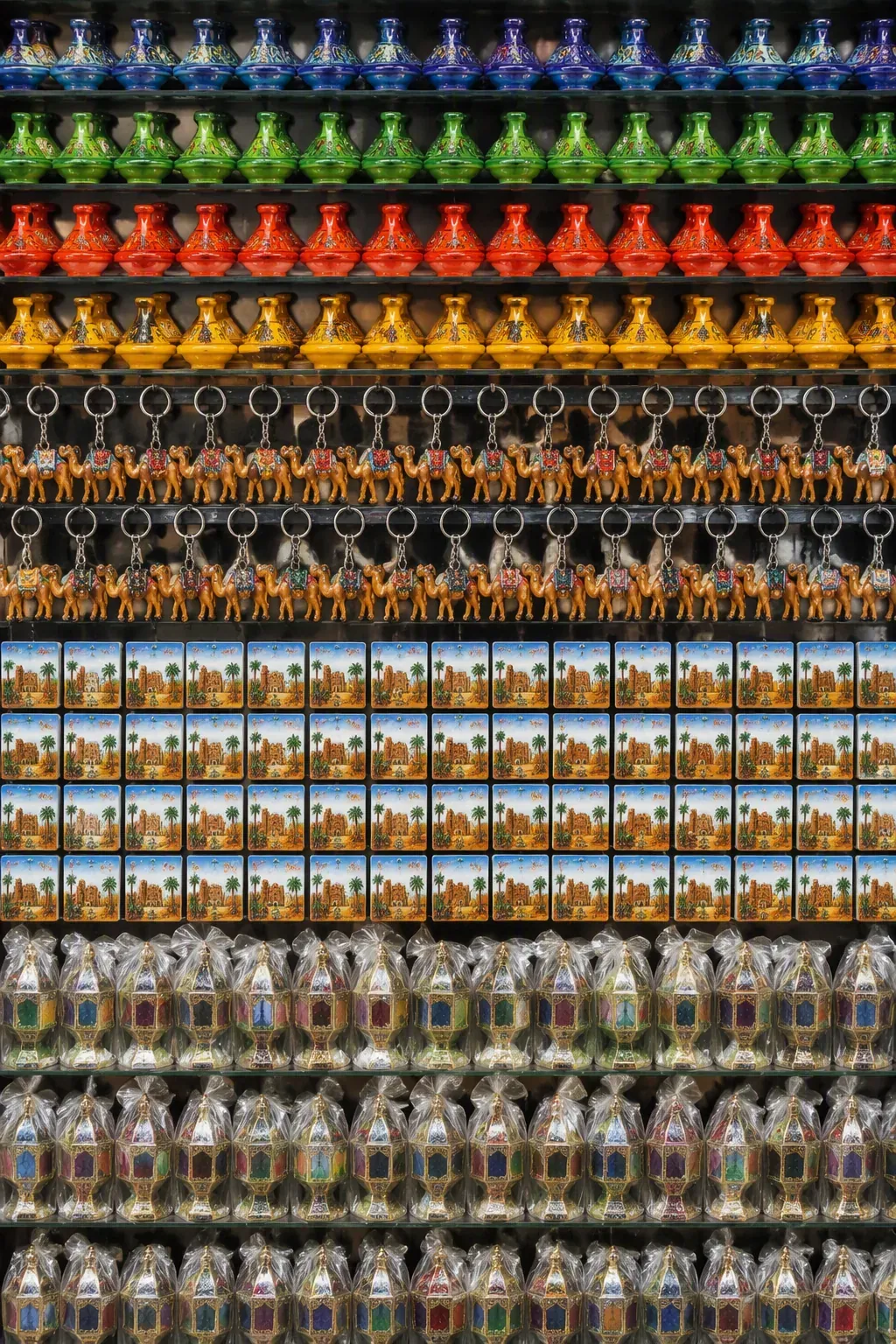
Mass production gives itself away: a decoration that floats on the material instead of being part of it, a pile where no piece differs from the next. On a fridge magnet, it doesn’t matter. It does when the object sells at workshop prices. The price is negotiated afterwards, and not in the same way depending on whether there is a workshop behind the counter. That is the subject of our page on how to haggle in the souks.
In a shop, “is it made here?” is the wrong question, since for silver or thuya the honest answer is no. Ask where it comes from, and who made it. Tiznit, Safi, the workshop at the back: that is an answer. “It’s Moroccan” is not.